Wednesday, June 11, 2014

Eric Cantor Loses Primary in Spite of the Fact He Sucked as Majority Leader


Eric Cantor posing next to American flag, symbolizing his deep policy priorities.

I'm sorry for Eric Cantor, I really am. As Majority Leader of the U.S. House of Representatives, he got next to nothing done during his tenure. Either he championed causes -- like repealing Obamacare -- that were doomed to defeat or he opposed causes -- job training, budget deals, gun control -- that would hand Barack Obama a policy victory. In the end, he got absolutely nothing done, except, perhaps, arranging to have the credit rating of the U.S. lowered twice because of obstructionism (the actual cause for the credit downgrades, by the way).

He strutted around with the "leadership," stood around with them at photo ops, then oops got booted. With his impressive record, he should be a lobbyist in no time.

Note. It's possible that his "support" for immigration reform did factor into his loss. But remember, he never had any intention of bringing immigration reform to the floor, ever. He just hoped that he could feint support for Hispanic causes. Oops, backfired. He got fired by his own conservative brethren. Now, the result is Hispanics know the right despises them. Uh oh, 2016.

Tuesday, June 10, 2014

Over the Past Thirtysome Years, the Government Lowered Taxes. With What Result?


Conservatives idolize Reagan. Why? For starting our long, steady decline? For
helping jump-start income inequality? For starting the trickle down that never did?

Have wages gone up for the middle class? No. Have the wealthy gotten wealthier? Heck yeah. Do we think our government services are better? No. Do we think government is more effective? No.

So why did we cut taxes? So life would be better in America? Maybe so. Did it work? Doesn't look like it.

What are the chances we'll raise taxes on the wealthy to achieve a more equitable society? Not likely. What are the chances we'll pass laws that encourage labor unionization, even though we know that the demise of the labor movement coincided with the long slide into stagnant wages? Not likely. Unions have become very unpopular, even demonized.

Let's do a Harpers sort of thing.

Decrease in federal minimum wage, over the last 46 years:


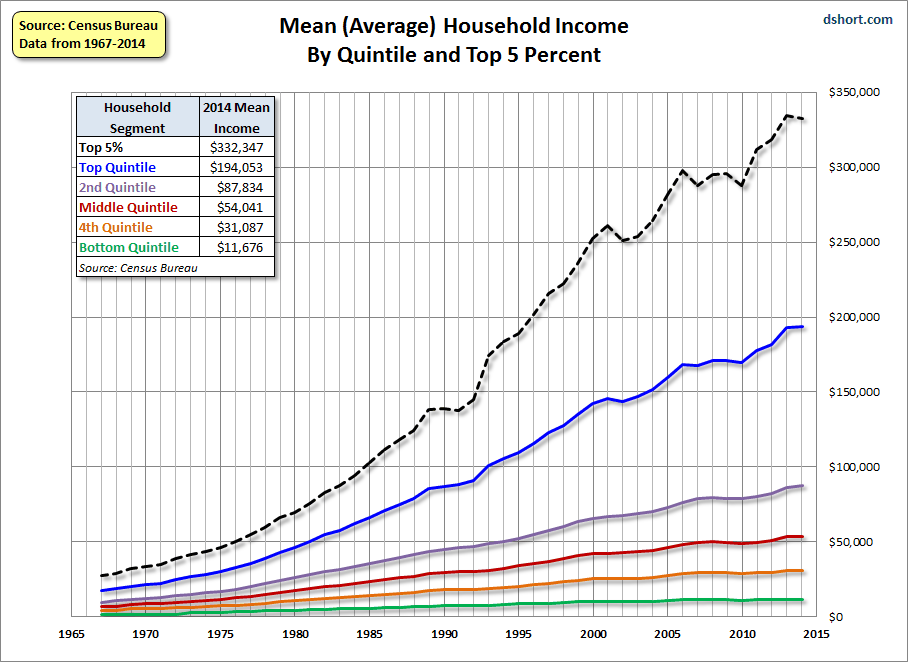
Increase in income by quintile, plus top 5%:


Graph showing bottom two quintiles spending more than they make:


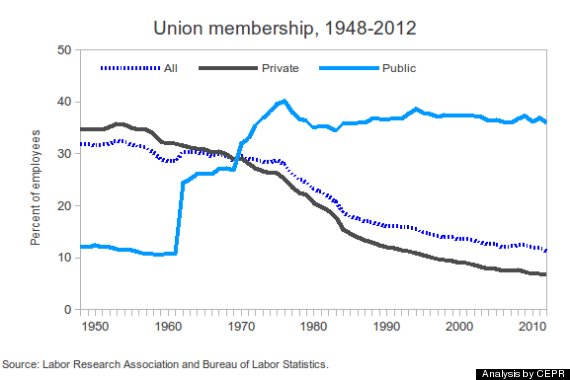
The decline of unionism:


 Top-bracket tax rates, since inception of federal income tax, with trend line:


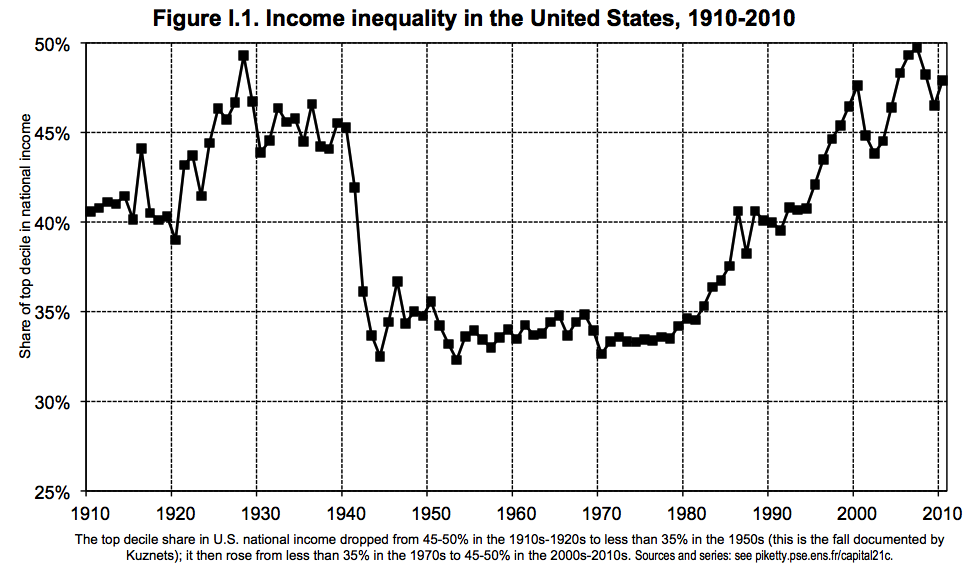
 One hundred years of income inequality:


The last two charts are very telling: Historically, income inequality in the U.S. tracks top marginal tax rates. Look at income inequality's rise since 1980. That tracks the continuously lowered tax rates beginning with Reagan and ending with Bush II, with an assist from Obama, who only restored the higher tax rates on the very highest earners.

Now compare this with the flatness of the minimum wage increases over time. In fact, in real dollars, the minimum wage is below where it was in the 1970s. In addition, the lowest four quintiles have nearly flat wage increases, while the top quinitle does markedly better. The top 5% put the rest in the dust. In truth, a large portion of the top 5%'s income rise is actually due to the terrific increases in those of the top 1% and even the top .1%.

As the minimum wage has lost ground since the 70s, and wage growth in general has been flat since then, it's not surprising seeing union participation begin to fall in the 1970s, as well. The union movement in great part gave us the American middle class. Now its decline tracks the decline of the middle class. You don't have to be a fan of unionism to see the connection.

Look, finally, at the the graph that shows household after-tax income and expenses. The bottom two quintiles make less than their expenses. How could this be so? Either the poor and very poor get by with food stamps and other assistance, or they acquire debt, sometimes at exorbitant rates from Payday loans. A third component is that some of the bottom two quintiles are seniors spending down savings. Some estimates place this share at 25% or fewer of Americans. Senior poverty is rarer these days, for obvious reasons. In any event, the poor and very poor, whether seniors or not, don't make enough to get by without assistance or acquiring debt or spending down savings.

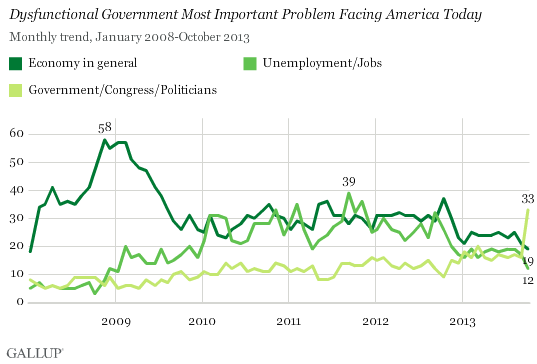
Now, there's one last piece to this puzzle. Satisfaction with government:


The first chart shows satisfaction with government at an all-time low of 18%. The second chart shows "dysfunctional government" being the number-one problem facing America, easily surpassing the economy or jobs.

My conclusion: If real wages are flat or even falling for some quintiles, and taxes on the rich are considerably lower than when Reagan began slashing them in 1981, and the wealthiest Americans are even more wealthy today than at anytime since just before the 1929 stock-market crash, and satisfaction and opinion of government are at historic highs, why would anybody believe that our economic policies have been wise in the past 35 years?

The trends all track or mirror each other. So, the way to fix this is:
  1. Raise the minimum wage to as high as $12, even $15.
  2. Encourage unionism to support middle-class-level wages.
  3. Raise taxes back to pre-Reagan levels.
  4. Spend new revenues on discretionary non-defense spending, especially on education, job training, health care, safety-net programs, and shoring up, not cutting, Medicare. Social Security can be extended nearly indefinitely by raising the cap on FICA taxes. And, yes, by all means, pour money into infrastructure spending. That supports the economy and encourages businesses to locate in the U.S.
  5. States should find a way to make college more affordable, even free. Europe does it, Australia does it. So can we.
I don't even have to present graphs about rising college tuition or rising student debt, but they're a huge part of our current dilemma. Education has always been touted as the portal to the American Dream. That portal is slammed shut for many Americans, and those that build up huge student debt are being denied an easy entry into the American economy. In fact, they're a principal drain on the American economy. Fix higher education spending, and fix the economy at the same time.

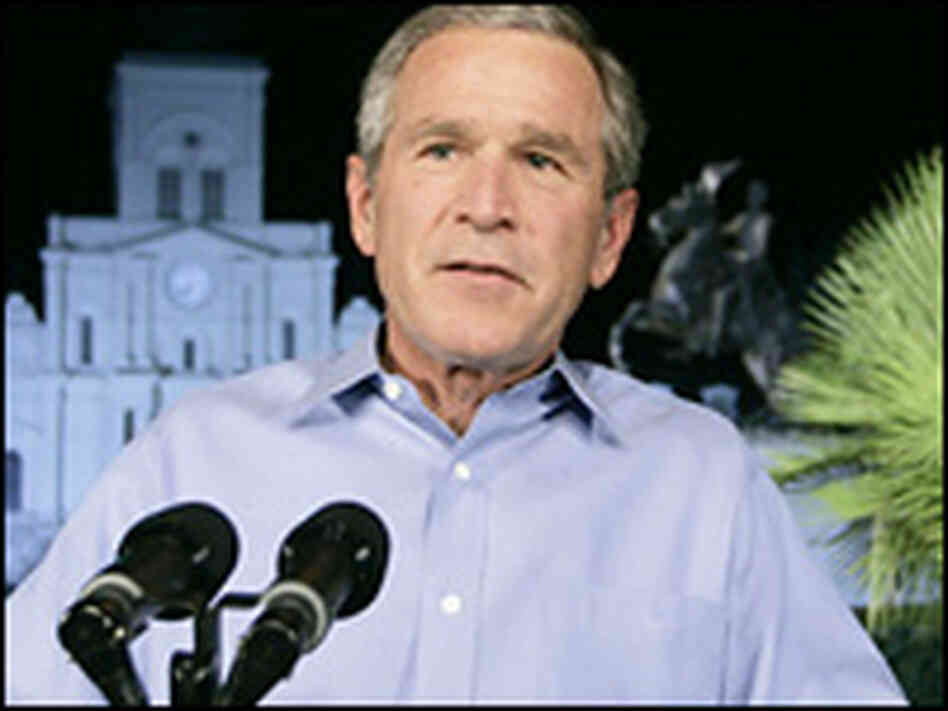
A last comment: If you look at the satisfaction with government chart, you see that the figure went negative around 2005. That, friends, is Hurricane Katrina. Why? That was the turning point. George W. Bush's performance was so bad that his numbers plummeted and along with them trust in government, from which its reputation has never recovered.

It's funny. Satisfaction and trust in government don't historically track the level of taxation. If the government is effective, people don't mind paying taxes. That's been true since taxes first started being collected.

George W. Bush looking at Katrina damage: The moment trust in government ended.

Bush in Jackson Square. Hopelessly clueless, and people stopped believing.

Heckuva job. We can do better. We must. What needs to be done, only government can do. Time to get to work, actual work.

Saturday, June 7, 2014

Finally, a Way to Understand -- and Support -- Net Neutrality


John Oliver did all of us a solid: He explained net neutrality and why it's vital we support it and not let the cable cartel bamboozle the FCC (hint, the FCC is not bamboozled, we are).


Do follow his recommendation and go comment -- in favor of net neutrality -- at the FCC comments page on the Internet.

If you need some inspiration, read this to discover you're not alone if you hate your cable company (I hate mine, Comcast, and I'm leaving it as soon as my mandatory 2-year contract is up.)

Tell your friends. This is too important to ignore.

Friday, June 6, 2014

If You Ever Thought the American Dream Was Real, Do You Now?

Simple answers to simple questions: Maybe yeah, but you really shouldn't anymore.

Somebody's dream home.

The American Dream was based on the idea that we all have a shot. We all don't have a shot. In fact, the shot that some of us had was so hopelessly gamed -- most especially during the housing bubble -- that many of us never had a chance. It took dumb luck, like I had, to not get crushed. And even then, the odds were stacked against us.

I remember the 1968 Democratic Convention in Chicago in which hundreds of demonstrators were beaten and arrested. They were carted off in droves, with the "authorities" saying it was the protestors' fault. Later, after an extensive investigation, the mayhem was declared to have been a "police riot." That's right, the police went crazy, beat and gassed people, drove them into corners where they couldn't escape, and then arrested them for resisting arrest. It was a travesty.

What happened during the housing bubble was very much the same. The usual suspects -- here's one of them, and another one -- say there was nothing the government could do to protect the homeowners that got swept up. But it's not true. Basically, the housing bubble was a bank riot, a bunch of banks that ran wild, issuing loans willy-nilly, then robo-signing their foreclosure papers, and avoiding millions in property and deed transfer fees by creating a fake electronic transfer system that no one really approved -- as far as I know -- and in the end, the Fed or Fannie or Freddie ate all the bad paper. The banks were made whole. The people? Not so much. The towns and cities, with the crap foreclosed homes falling apart? Not so much.

My family was not immune. We were actually damaged by it. One of my brothers, who was virtually unemployable and hadn't held down a job in several years, was offered a no-doc loan for $350,000. When I told him I seriously doubted it, he was so insulted, he stopped talking to me. (And I was wrong: Washington Mutual had pre-approved him for the no-doc loan.) My other brother, when I told him there was bubble and that we should sell the family home before it was too late, didn't believe me (our last parent had died, this was in the process of unraveling an estate). Instead, he borrowed heavily -- yep, a virtual no-doc loan from, yep, Washington Mutual (this brother hadn't worked in seven years, long story) -- and bought the family home for himself. He poured money into updating it, lived in it for a couple of years, and then put it on the market. He lost more than his entire worth at the end of the whole process (sold it for more than $200,000 LESS than an offer he turned down in 2007). He was sixty-six, with no income other than Social Security. He, too, doesn't talk to me.

I've made this personal to make a point, and that's that the collapse of the American Dream can break families in ways that aren't always obvious. I can live with the estrangement of my older brothers. What else am I going to do? Imagine all the other myriad ways the housing collapse shattered families. They're countless, each its own individual tragedy.

It didn't have to be this way, but the Big Boys Who Make the Rules said so, yes, this is too the way it goes.

So bye bye American Dream.

Former Treasury Secretary Timothy Geithner, left. Said he'd help homeowners,
then didn't. Said he couldn't. Right. That must have been it, he couldn't.

Thursday, June 5, 2014

Boycott National Companies That Pay Below $10.10 an Hour. It's That Simple.


Twenty companies with the most low-wage workers.

I haven't shopped at Walmart in 20 years anyway. Some time maybe two years ago, I ate at McDonald's and said, "Shit, this is shitty food." Same thing a year ago at Taco Bell. Their tortillas taste like cardboard. Now I've stopped thinking outside the bun. I don't go near them. I eat at my local taqueria. A little more expensive, but great!

They probably don't pay any more than Taco Bell, but that's not the point. Here's the point: If everyone picked the top-ten corporations that should be paying a higher minimum wage but aren't, and stopped shopping there ever, we'd see a $10 or higher minimum wage in no time. Seriously,

What, are they just going to let sales slip 5 percent? Their stock would tank. Again, you'd be eating better. Shop the sales at the really local chains. Skip Macy's. Seeing their name in the top twenty gives me the willies. Their workers can't afford to shop there!

Boycotting national food joints and retailers that pay below $10.10 should be a no-brainer. For example, make In-N-Out Burger your go-to burger joint (It's mine since I abandoned my juvenile attachment to McDonald's). Make Costco your go-to big-box store. Shun TJMax (I'm cutting up my card today). Nordstrom pays a decent wage. I might make Nordstrom Rack my go-to clothing discounter. Encourage everyone you know to do the same.

Now, the beauty of this is that is skips the mom-and-pop dilemma -- joints that supposedly would get hurt by a higher minimum wage. Go ahead, go to your local non-chain burger joint. Encourage them to pay their workers more, reminding them that better-paid workers are more loyal (thus you don't have to train new workers so much), more reliable, more retainable, and don't steal everything they can get they hands on. But support them if you think they're worthy.


Bowe Bergdahl Didn't Desert. Good Luck convincing anybody.


Bowe Bergdahl, hardened criminal.

It has been verified that Bowe Bergdahl was captured by Afghanis within thirty minutes of leaving his post. A soldier is not a deserter until he's been gone thirty days.

This doesn't resolve the issue of why he left in the first place. We don't know that yet.

But when listening to the GOP-rounded-up gang of media specialists from Bergdahl's platoon (and, yes, GOP operatives are behind the media onslaught), remember that saying something doesn't make it so.

Another important fact: Bowe Bergdahl was the last POW from Iraq and Afghanistan. Now there are none.

Another important fact: The five "high-value" Taliban that we traded were being illegally held or at least would be if not released at the end of the Afghanistan War. There are no charges against them. We were going to have to release them anyway, unless of course you're in favor of doing illegal things, which since Bush/Cheney may be the-way-we-conduct-business-since-9/11.

America fuck yeah! Except Bergdahl. Fuck him. That's just the way we roll! Semper Fi!

My actual opinion: The way the Bowe Bergdahl release from five years of captivity has been handled politically and in the media represents one of the darkest hours in an already dark era of American politics. It's disgraceful in so many ways. Bergdahl may not be an exemplary soldier. "Hero" former Vietnam vet and Nebraska senator Bob Kerrey may be an example of another possible non-exemplary soldier. Shit happens in war. Still... Kerrey killed women and children and got a Bronze Star. Bergdahl gets raked over the coals for taking an ill-advised walk.

America, fuck yeah!

Former Senator Bob Kerrey: What happened that night in the Vietnamese village
is "none of your damned business." He later served on the 9/11 Commission.

Little Tommy Friedman Misses So Badly It Hurts My Head


Proof that Little Tommy Friedman married well. Wish there was proof
he was rehabbed. He needs it, desperately.

Foreign affairs specialists like Little Tommy Friedman sometimes marry well. Good for him. But he shouldn't tout the American values we've introduced to Vietnam and Iraq. Blowing stuff and people up is rarely a project for passing on the best America has to offer. The fact that we missed blowing up a part of a country doesn't make us special. It makes the people we didn't blow up special. At some point, Little Tommy Friedman needs to go away. Unfortunately, the New York Times hasn't decided that time is now. More's the pity. So he gets to publish stuff like this.

But don't fall for his crap. It makes Atrios' head explode. I can see why. Atrios long ago did the world the favor of flagging this video from a Charlie Rose appearance, which, in spite of how eloquently glib he was, should have gotten Friedman banned from the human race. It didn't and hasn't, but a man, and the human race, can dream.

Until then, Little Tommy Friedman gets to drop that he's the commencement speaker in the part of Iraq that was not forced to Suck. On. This. I see what Atrios means.

God, I used to admire this guy. Shame on me. But I went to rehab, and now I'm better. I don't know which of the 12 Steps I'm on, maybe the apology tour. I'm sorry, folks, if I ever caused you harm by praising Little Tommy Friedman. What's the next step? Going back to drink? That might work.

Friedman's official "I'm majorly relevant" portrait.