Sunday, October 7, 2012

In Today's Politics, It's True If It's Plausible.

I've been watching politics for a long time now, certainly more closely than is healthy for any stable mind, but so it goes. And the monkey on my back, my real jones, if you will, has always been, "But that's just not true!!"

How high was the bullshit piled up?
Every time John Boehner, Mitch McConnell, Paul Ryan, and other Republicans said, "It's a job killer and we're just not voting for it," or "raising taxes on the wealthy is class warfare and a job killer," or "Obamacare is a granny killer and, what the fuck, a job killer," I just shake my head and wonder why they say it. I inevitably grumble and concede that they say it because somebody's already drunk the Kool-Aid and in fact are now predisposed to believe these nonsensical pronouncements.

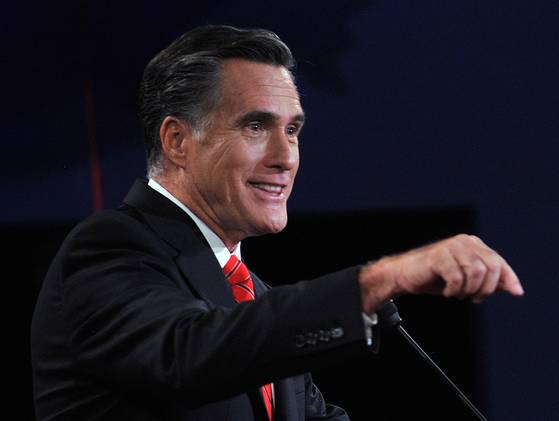
The other night when a new, improved Mitt Romney -- you know, the one equipped with a brand-new set of talking points quite nearly 100% reverse-engineered from the baloney he'd been spouting for the past 18 months -- opened his forceful, smiling, affable, Glengary Glen Ross, always closing, closing, closing, glad-handing, beaming mouth, I was flabbergasted. For about 48 hours.

Fine. I admit it. I forgot to bring my bullshit the other night.
That's how long it took for me to regain my footing. Sure, all the pundits and currently unemployed political consultants on TV said that Mitt Romney had wiped the floor with Barack Obama, and Andrew Sullivan had said that he knew traditional debating (probably from his days at Oxford) and what was Barack Obama thinking!!?!, and so forth. Yes, I'd watched just about every debate since JFK and Nixon (true, believe it or not), and I get that debating is about closing, not truth-telling per se, and yes, Obama had a bad night.

But in the scheme of things, the truth still matters to me, always has, always will. I've never been to Oxford, so I can't say, "Well done, old chap, you certainly bested me, it's was complete nonsense of course, but I digress, well done, old sport!"

Is American politics relevant to Afghanis? It's plausible.
No, politics is life-and-death issues, it means something. Just ask the Afghanis, or Americans without health insurance. It is life and death.

So how does this thing work, this political propaganda machine? How do misinformation campaigns really work? If Orwellian language really works, what's the key to it?

It's been right there all along, but I finally saw it: It's all about plausibility. Plausibility doesn't need to be fat and wide; it doesn't need to contain the truth. It needs the barest, the wispiest, the thinnest amount of rationality. All it needs is to be plausible.

Obama is really a Kenyan Muslim who hates America? It's not out of the realm of maybe, slightly, kinda crazy but, what if it's actually, really true? A wisp of plausibility? Great! Limbaugh and the fiercely yapping crowd will run with it all day and all night.

Let's try this out. There's this God, see -- well actually, no, you can't see Him -- and He knows our every thought because he's watching everyone and created everything forever and ever and we'll live with Him until the End of Days, and then the Evil ones all die and we live forever and ever on the Big Rock Candy Mountain! With God! Yeah, it's plausible.

Sullivan is a rationalist who believes in the Big Rock Candy Mountain.

You know what's plausible? The undeniable fact that you can't become president unless you believe something almost exactly like that, and you must make it undeniably clear or you're toast in a presidential election. This is not only plausible, it's true, and what makes it all the more outrageous, of course, is that this is how we operate in a nation founded, among other things, on the First Amendment, you know, the one that says no religion shall be established.
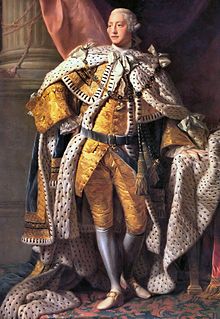
King George III. ruled by divine right?
I somewhat digress, but not really. I'm just having my I-can't-believe-it's-not-really-butter moment about politics. It's probably been like this from the beginning of time. The Egyptians believed in the Pharaoh, and the British revered King George III (did they actually? Hardly matters), and wait, wait. They actually didn't, the people I mean. They didn't know what to think, didn't have the power to affect outcomes and ruling by divine right was, in fact, well, plausible.

And so here we are today. Mitt Romney is no Pharaoh, he's just the Republican candidate for president, and the stage has been set for him to run, perhaps successfully, on talking points that are plausible. Do his positions have to be true? No. Do they have to be what he espoused in 1994? No. Do they have to be what he espoused in 2002? No. Do they have to be what he said on the stump up until last Tuesday? No. Okay, what do they have to be?

Let's say it together: plausible.

And what's Mitt going to say at the next debate? Who knows? But it'll be plausible. True? Who cares?

Mitt's hoping the answer to that final question is less than half of the people. Which is why he doesn't care about the 47%. That's more than plausible.

Update. We all get jokes and cute pictures in emails from friends. Some of them are amusing, some are not. A friend forwarded this joke to me, and I noticed its relevance to the above:
Snow White, Superman and Pinocchio are walking along. They see a sign: "Contest for World's Most Beautiful Woman." Snow White goes in, later comes out smiling, wearing a crown.

They walk along and see another sign: "Contest for World's Strongest Man." Superman goes in, later comes out smiling, wearing the belt.


They walk along and see a sign: "Contest for World's Greatest Liar." Pinocchio goes in, later comes out with his head down crying.


"Who the hell is Mitt Romney?" Pinocchio sobs.
That's funny. And plausible.

My tax plan, my tax returns, my health care plan, my education plan, my jobs plan...

Saturday, October 6, 2012

The (Almost) Age-Old Question: Who Is the Real Mitt Romney?

A kinder, gentler Romneybot?
The fact that the question is still up for debate points to the problem not of who Mitt Romney is -- it's possible to not even care -- but of what his election would mean to the nation, as an unnerving outcome as that is.

Romney's performance in the Wednesday-night debate kicked up a brand-new, take-two or -three discussion of his inner core -- if he has one -- akin to a 90-minute episode of "To Tell the Truth," for those boomers like myself who still remember the 50s quiz show. The original required two of the three contestants to defend false resumes in an attempt to stump the panel, provided all told the truth. In my new iteration, all three contestants are Mitt, and the truth is optional.

The denouement each week of "To Tell the Truth" was, "Will the real Mitt Romney please stand up." Indeed. Will he? has he? There is something riding on it besides egg on perennial panelist Bess Meyerson's face. There's maybe the future of the country.

So here we are a few days later, and John Dickerson of Slate comes out with a somewhat predictable "Who's Mitt, Anyway?" sort of article, based on the new Mitt of debate fame, the finally Etch-A-Sketched, more moderate, less scary, even, uh, warm and fuzzy guy you actually would like to have a beer with if Mormons only drank.

Dickerson:
But finding the essential Romney isn’t so simple. The experiment itself is flawed. Voters are being asked to detect the truth from two different acts of artifice. One is a set-piece performance recorded by the television networks. The other was a set-piece performance captured by a member of the catering staff. Both are performances. Like all politicians, Romney was playing to the crowd in both cases. The question is not which one represents the true Romney, but which crowd will he play to when he’s in office.
Undecided voters caught undeciding.
As Atrios would say, holy crap. But Dickerson nails it, and the implications of this insight is, while not necessarily frightening, deeply aggravating. Can it really be that we could likely elect someone we barely know because, well, who knows? His true believers? The Obama-haters from day one? The undecideds? The independents? The press? The disenchanted??

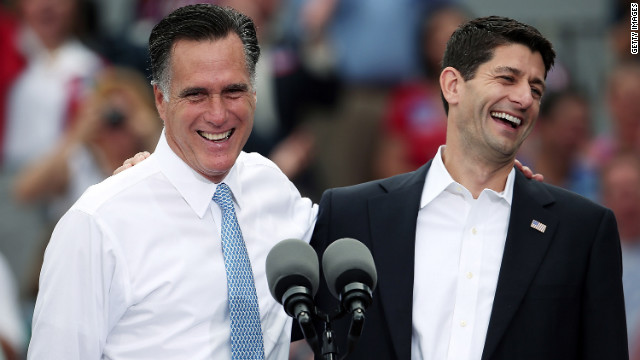
Why, of course, should be the ultimate question, but that's understandably harder to get to. From my perspective, he and his running mate Paul Ryan are both heavily Etch-A-Sketched: one, Romney, by himself and his consultants and the other, Ryan, by a beltway press corps in search of someone resembling an intellectual, policy-wonk conservative. Unfortunately but predictably, what you see is most decidedly not what you get.

Here's more grist for the mill: This morning's New York Times headline read, "Romney Claims of Bipartisanship as Governor Face Challenge," which is impartial reporter gobbledegook for Romney lied his ass off. From the article by Michael Wines:
As a Republican governor whose legislature was 87 percent Democratic, Mr. Romney said in Wednesday’s debate, “I figured out from Day 1 I had to get along, and I had to work across the aisle to get anything done.” The result, he said, was that “we drove our schools to be No. 1 in the nation. We cut taxes 19 times.”
But on closer examination, the record as governor he alluded to looks considerably less burnished than Mr. Romney suggested. Bipartisanship was in short supply; Statehouse Democrats complained he variously ignored, insulted or opposed them, with intermittent charm offensives. He vetoed scores of legislative initiatives and excised budget line items a remarkable 844 times, according to the nonpartisan research group Factcheck.org. Lawmakers reciprocated by quickly overriding the vast bulk of them.
 How quickly reporters can debunk politicians' statements. But once the propaganda propagates, does it take on a life of its own? Political consultants know the answer: Fuck yeah.

Post-debate conventional wisdom? Dude's toast. No, French toast.

I got a chuckle but no solace from Andrew Sullivan's blog post, "Rebooting the Romneybot." That this title is not salacious tells a lot about both Romney and our political culture:
The reinvention effort includes softening the edges of Romney, both stylistically and philosophically. The more likable version of Romney was no accident — he worked hours on his smile, his posture and the delivery of his words. The more centrist version of Romney was no accident either — he carefully calibrated his message on taxes, spending and Medicare to broaden his appeal.
...The goal was to overwhelm the president with liveliness and information, to force him to confront the messy details of his economic and fiscal record.
Carefully calibrating his message on taxes, spending and Medicare, my ass. He lied, hoping people would lap it up. Over at the Daily Beast, historian Simon Schama let loose on Romney on the falsehoods and on Obama for his dismally dispiriting performance:
As the whoppers tumbled from his smiling lips, Pinocchio Romney’s nose grew so long that it was practically poking out the eye of his mournful opponent. But even had it struck raw cornea, the president would have politely removed the intruding proboscis to say, “Governor Romney, I probably agree that the nation could do with a good eye watering, though we disagree on the manner in which it would be administered,” or some such snappy retort.
Romney lies, truth dies is not a lame pronouncement: It's the observation du jour, today as it was yesterday, and so forth. Here's Michelle Goldberg, also of the Beast:
The way Obama kept looking down instead of directly into the camera was maddening. So were his seemingly unrehearsed, defensive answers. But the most painful part was watching Romney lie so brazenly, while over and over again Obama failed to effectively challenge him. Romney repeatedly insisted, for example, that he has no plans to reduce the tax burden on the richest Americans. This directly contradicts the analysis of every nonpartisan expert who has looked at Romney’s plan.
...Perhaps Obama, feeling comfortable in his lead, didn’t want to get down in the muck and call Romney a liar, or perhaps he was just unprepared for the level of deceit on display. Debating someone who is willing to simply make things up is incredibly discombobulating. Regardless, it means that most viewers will be left with a seriously distorted view of what the Republican candidate is proposing. Tomorrow, the fact-checkers will try to correct the record, but the Romney campaign has already decided that facts don’t matter.
And so it goes. For the record, I didn't go to see what William Kristol, Jonah Goldberg, Jennifer Rubin, or Fred Barnes had to say about the factual basis of the new Romneybot because they're hardly invested in the truth. They're interested in the fight and its outcome. They're all in for their bot.

Okay, I did go read Charles Krauthammer's column on the debate. Ugh. Read it at your peril.

Kristol, pointing to his as yet unemployed Romney bullshit detector.

As Michelle Goldberg titled her Beast report above, Romney won, and the truth lost. There are few mourners for the truth on the right, not while they smell blood. On the left, there's anxiety aplenty about whether Obama can help truth make a comeback. We have a month and three more debates to find out.

Post-debate polls pile up. (h/t Andrew Sullivan)

Friday, October 5, 2012

Good Jobs News: Those Chicago Bastards!

Stock market is soaring: those Chicago bastards!

Yea! Jobs came in reasonably good if you add in the upward revisions of July and August. So, dropping to 7.8% isn't crazy. Unless, of course, your team wanted bad. Then it's all "those Chicago bastards, just how low can they crawl, down with the lizards, newts, and salamanders. Bastards!"

Jobs are still up: those Chicago bastards!

And you know, the Tax Policy Center says that Mitt Romney's tax plan doesn't add up. And everyone who looks at Paul Ryan's budget agrees that the numbers don't add up. And when you look at their Medicare plan, it means that eventually Medicare will end as we know it (you know, the part where you die when you run out of money from your voucher, which is sort of the whole idea now where you don't die because you run out of money. But hell, tough choices! It's the marketplace! Whoopee!)

Our numbers don't add up, of course they don't. Why? Those Chicago bastards!

Sorry, Republican Party, you get to campaign on the numbers you have, not the numbers you wished you had. This week, the numbers look good for America. So your job, Republicans, is to explain why everything is bad anyway. The party of Doom and Gloom! That's gonna work for sure.

Jobs report is good, July and August revised upward. Romney has a sad. Chicago bastards!

I could link to all the conspiracy theorists, BLStruthers as Josh calls them, but I'd rather link to Paul Krugman's Friday column. It doesn't give me a sad or make me cry out "those Boston bastards!" Well, maybe a little. Sorry. Enjoy the good jobs numbers and have a BBQ this weekend. I intend to.

Update. I couldn't help myself. Here's Jack Welch's tweet this morning:


Here's Fox on the warpath. Good news, not on Fox:


Monica Crowley on Fox Business takes good news and turns it into a shaky, political "you see what you want to see, it's really sort of bad" story:

Holy crap. CNBC goes jobs truther:


We've so civilized nowadays...


Can't really pretend to have visited Wingnutistan unless you check in with Rush:


Rush plays a little "trick" on us. He says the jobless rate went from 8.3% to 7.8%, making it sound implausible. That's because the rate went from 8.1% to 7.8%. C'mon Rush, you can be wacky without the tricks, okay?

Have a good weekend, and if you're a Republican, don't worry, some day you'll get the lousy jobs report you want. If you don't just retweet Jack Welch. Cheers.

Thursday, October 4, 2012

Romney in Fantasyland at the Debate: Will It Work?


Romney, left, greets Obama at the first debate.

I watched and listened to every word at the debate last night. I came away with this immediate impression:
  • Romney "looked" better, more prepared. However, he did this at some expense. His alpha-male, hard-charging, salesman approach combined the con man with the bully.
  • Romney finally had his Etch-A-Sketch moment, which required him to play fast and loose with the truth. Yes, he seemed in command of the facts. Only problem was that most of them were false. The rest were, ah, what did he actually say? And who's buying it? His supporters? Yes. Obama's supporters? No. The undecideds? Maybe. Maybe, however, is the modus operandi of the undecideds.
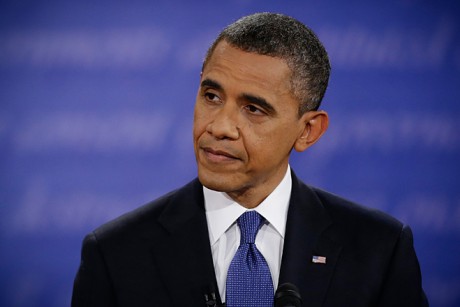
  • Obama appeared not up to the task at hand in real time. He did successfully challenge a few points and did work to explain his stands on issues. By and large, though, he almost seemed to cede many points to Romney. Since many of Romney's points were false, it occurred to me that Obama was playing long ball here. I suspected that as the debate went along, his team was feverishly sifting through the vibrant, somewhat overcaffeinated Romney display of scattershot policy mongering, all the while looking for what misstatement would go into tomorrow's ad. (Later in the post I'll show what's already being produced. God, there's so much video!)
  • Was this really rope-a-dope or Obama having a bad night? Hard to tell. I saw a few comments in the Twitterverse and blogosphere that suggested Obama couldn't be the angry black man. Sounds plausible, but in 2012? Maybe for the undecideds. But that's their favorite word: maybe. (Maybe I hate angry black men? Maybe I'll vote for the white bully across the stage? I don't know.)
So that's what I thought about last night. It's easy to start out depressed this morning if you're a disappointed Obama fan -- I am both. But let's look at a few things:

Obama: “Thank goodness somebody is finally getting tough on Big Bird. It is about time.”

How to win friends and influence voters?

Yep, Obama's team was ready. This was out this morning:


Okay, found this on Daily Kos from Bill in Portland Maine, who might be gay (duh). It's unrelated to last night's debate, but food for thought anyway:


Yes, not about the debate, but very appealing and I'm wondering, looking at this web ad: Did Mitt Romney win these people over during the debate? Which misrepresented factoid won over these people? A quicktake gay reaction from a HuffPost writer here. (Gays saw the bullying, BTW.)

I don't know which is more surprising, that "The Situation" is doing a "Jersey Shore" sober, or that Hollywood actually is in the tank for Obama, during and post-debate:


WonkBook on WaPo did a credible job of insta-factchecking An example:
9:09pm: Mitt Romney says he’s not going to cut taxes for the rich. According to the Tax Policy Center, even if he were to cut all tax breaks - save for those he’s promised to preserve - for high-income people, people making over $1 million a year would get an average tax break of $87,117.
This is the kind of fact-checking I like. Straight fact-checking and a very good read. Another good read to parse the debate is NPR's "Romney Goes On Offense, Pays For It In First Wave Of Fact Checks." This backs my theory that, beyond the trad media's "optics," the facts might not settle in Romney's favor over the final weeks -- and remaining two debates.

I don't know who put this up on YouTube, but Andrew Sullivan links to it as an Obama ad:


In undeserved fairness to loudmouth Mitt, Obama out-talked Romney by four minutes, but the above scene captured Romney's petulance.

I like to read Andrew Sullivan's blog, The Dish, to get a different perspective on issues (sift through his "reax" going back, to get a broad picture of debate opinion, Dish-style). Andrew is gay, Catholic, and conservative (in the traditional, not rabid, tea-party sense). He's evolved from supporting Bush and the Iraq War into a Kerry and Obama supporter in the last two elections and has since recanted (with mea culpas) his Iraq-War stance.

Last night he was quite hyper-ventilated at how badly Obama performed and how well Romney did, in spite of the fact that he saw through Romney's flim-flam. He links to an Urtak set of polls he conducted post-debate. Most interesting factoid: 82% of those polled thought Romney won the debate, while 93% of same still intend to vote for Obama. As a good control-group question, 93% of same voted for Obama last time. These are Andrew's readers, so I don't know if that implies that the debate barely moved the needle overall. But it didn't budge for readers of The Dish, apparently.

Obama the day after in Denver, calling Mitt out. Too late?

According to the Huffington Post, Barack went after Romney 13 hours too late. Sizzling quote from Obama's Denver speech:
President Barack Obama is challenging Republican Mitt Romney's candor the morning after their first debate, saying: "If you want to be president, you owe the American people the truth."
Obama said at a rally in Denver on Thursday that at the debate he met "this very spirited fellow who claimed to be Mitt Romney." But he says it couldn't have been his Republican rival because he says Romney misrepresented his own position on taxes, education and the outsourcing of jobs.
In tough comments, the president says Romney, quote, "does not want to be held accountable ... because he knows full well that we don't want what he's selling."
This backs my idea that Obama was happy enough to sift through Romney's bunk-apalooza to attack him later. I wonder about such an approach. Rope-a-dope or Monday-morning quarterbacking? We'll see.

The Artful Dodger?

Salon.com fact-checks the debate. I was surprised that none of Obama's facts were disputed.

Salon's Joan Walsh wondered why Obama didn't dispute some of Romney's falsehoods:
Romney shook his Etch-a-Sketch and lied his way through the entire debate with no challenge from moderator Jim Lehrer. He simply denied he has proposed a $5 trillion tax cut. He insisted he wouldn’t cut the education budget or Pell Grants, when he will. He claimed the Affordable Care Act raised taxes by a trillion dollars. He essentially revived the idea of death panels by saying Obamacare established “a board that will tell people what kind of treatment they’re going to get.”  Yet the president didn’t call him on any of it.
Yeah, I wondered, too. But, ah, rope-a-dope? My wishful thinking?

Here's Jonathan Chait's reaction:
Romney won the debate in no small part because he adopted a policy of simply lying about his policies. Probably the best way to understand Obama’s listless performance is that he was prepared to debate the claims Romney has been making for the entire campaign, and Romney switched up and started making different and utterly bogus ones. Obama, perhaps, was not prepared for that, and he certainly didn’t think quickly enough on his feet to adjust to it.
I wish I could, but I can't argue with that. Will this be a lasting assessment? Who knows. My tentative assessment is that, in the first debate, Mitt Romney seriously detoured into Fantasyland. Will the voters follow?

I got your black ass, didn't I? You know I did.

Wednesday, October 3, 2012

The Post-Election World: Whither Goes Social Security?

Cue the timpani, then the snare, and rimshot! Ta-da! What will happen with Social Security after an Obama election? Nothing. Or possibly it will be improved or strengthened (or weakened, if Paul Krugman's suspicions are correct). I have ideas how to strengthen it, some from the experts I've seen over the years and a new idea of my own that I really believe in.

Members of the 47% telling Mitt Romney what he can do with his "victims" comment.

Now, truth be told, regardless of what a dismal man I think Mitt Romney is -- or how dishonest his veep pick is, Paul "wonky-but-math-is-hard" Ryan -- the fact is even if Romney wins, Social Security is essentially safe because, well, most politicians might talk tough but very few of them are suicide bombers. No, it's in the area of Medicare and Medicaid that Romney and the Republicans could make the most mischief because, well, suffering is good and we're all gonna die, so hurry up, except us.

There are good ideas out there for strengthening Social Security, and the first step to take is to say, "Yes, Social Security is good, and we must make it better, as well as more equitable." What steps can we take to strengthen it? Robert Reich:
Former Labor Sec. Robert Reich
Remember, the Social Security payroll tax applies only to earnings up to a certain ceiling. (That ceiling is now $106,800.) The ceiling rises every year according to a formula roughly matching inflation.
Back in 1983, the ceiling was set so the Social Security payroll tax would hit 90 percent of all wages covered by Social Security. That 90 percent figure was built into the Greenspan Commission’s fixes. The Commission assumed that, as the ceiling rose with inflation, the Social Security payroll tax would continue to hit 90 percent of total income.
Today, though, the Social Security payroll tax hits only about 84 percent of total income.
It went from 90 percent to 84 percent because a larger and larger portion of total income has gone to the top. In 1983, the richest 1 percent of Americans got 11.6 percent of total income. Today the top 1 percent takes in more than 20 percent.
If we want to go back to 90 percent, the ceiling on income subject to the Social Security tax would need to be raised to $180,000.
Presto. Social Security’s long-term (beyond 26 years from now) problem would be solved.
That's not so hard, is it? In fact, what it does is solve the input problem without adding an output problem. That's what I don't like about means testing: We would exclude a class of people from a public benefit. That's not fair -- especially if they've contributed to the program -- and we would be establishing the principle that paying in gets you nothing. And it's a needless exclusion to begin with.

(It's the same with Medicare, only worse. If you exclude wealthy people from the input pool -- those who pay in -- you don't enjoy the input. If you then exclude them from the output pool -- those who benefit from the coverage -- then you lessen the number of healthy people in the pool because wealthy, generally more educated people tend to be healthier anyway.)

Just tweak the system by raising the input from those who can afford it.

Let's hear from Dean Baker:
Dean Baker, CEPR
Even if no changes were made to Social Security, the trust fund could always pay close to 80 percent of scheduled benefits, says Baker, and while it would be unacceptable to pay people a smaller benefit than had been promised, the scheduled benefits for new retirees are projected to rise by 1 percent a year in excess of prices.
“This means that in 2036, the average scheduled benefit for a new retiree will be more than 25 percent higher than it is today,” Baker says. Even if no changes are made to the system, new retirees in 2036 receiving just 80 percent of their scheduled benefit would still be receiving a benefit that is larger than what retirees get today.

“In other words, there is no plausible story in which our children or grandchildren will have to worry that there won't be anything there for them.”
Boomers: The years are golden, but for how long?
A point I've always wondered about is how many years, in fact, it will take to bring the pressure of the swelling ranks of Social Security recipients down to more palatable levels, as the boomers pass from this mortal coil. From an MSNBC report:

This projection has triggered much political infighting over whether the United States should be cutting Social Security benefits or raising taxes to pay for them.
But those calculations are based on the expectation that the constant improvements in mortality (fewer deaths at every age) would continue unabated. The trustees project mortality declining by roughly 0.77 percent a year for every year going forward as far as the eye can see.
"We're simply projecting that improvements will occur at roughly the same... (rate) as in the past," Stephen Goss, chief actuary for the Social Security Administration, told Reuters.
The agency's math relies on this assumption: the average 65-year-old in 2020 can be expected to live 19.4 more years if a man and 21.3 more years if a woman. By 2030, when the last baby boomer turns 66, the average 65-year-old woman could expect to live to 87.9 and the average 65-year-old man would live to 86.
What if the trustees are wrong? If mortality rates stopped improving, and remained constant over the next 75 years, that would cut the OASDI actuarial deficit by about 0.45 percent of payroll, about one sixth of the projected shortfall over the next 75 years, a Social Security spokesperson told Reuters. That won't completely save the trust fund from shortfalls, but it would help.
A Silver Tsunami, or a Golden Sayonara?
A little creepy, but that would help. My idea was, generally, that it would take about 20 years for a significant shrinkage of the boomer population -- which dovetails nicely with the 2036 Social Security "cliff," so I'll accept, for now, this Fort Morgan Times editorial saying roughly the same thing:
Some are calling it a Silver Tsunami.
With expanding life spans, these people will need care for quite some time, but these times will not last. The sad truth is that most Baby Boomers have not planned for retirement beyond paying their social security tax, so they will not have the big bucks to pay for more than basic health care, even with Medicare.
Twenty years from now, the Baby Boom generation will be dying off rapidly. Yes, it will happen somewhat gradually, but not too gradually. What will happen to the health care industry then? Will health care employees have plans for other careers?
For that matter, what will many employees in any number of fields do?
With the demise of a huge portion of the population, less housing will be needed, less food will be needed and there will be fewer jobs for meeting Baby Boomer needs and desires.
If we planned for this retirement for 20 years, it is best to plan for the loss of this large segment of society over the next 20 years. Some will last longer, but do not expect that many to live into their 90s.
Spreading the wealth around? Why not?
Again, happy talk, but we have to face it. (I'd discount, by the way, the concern about shrinking demand. There will still likely be labor shortages because of the absence of the baby boomer workers, so shrinking supply will match shrinking demand, or immigration will help strike the balance.) About 20 years from now, if we bide our time and do the tweaks suggested by Robert Reich, Dean Baker, and a lot of other sensible people, all we have to worry about is a labor shortage to fill all the boomers' shoes, as well as a burgeoning Social Security trust fund, as Gen-Xers start to pore their FICA into the pool that needs to serve fewer retirees. Yipee.

There's an enhancement to our Social Security system that's worth considering. Back in 2005 when George W. Bush mistakenly identified a squeaker of an election as a mandate to privatize Social Security, he experienced a smackdown of epic proportions. His notion was a disaster in search of a calamity. Two elections later the Republican Party was still reeling.

We don't need to privatize Social Security, but it might be smart to encourage Americans to not rely on it exclusively for their retirement. Americans famously undersave for their golden years, so why not encourage additional savings? Here's a simple idea for how to do it.

Add a new layer to the already existing Social Security. Here's how:
  1. Continue the usual FICA payroll tax, which goes into the usual Social Security account.
  2. Enact a Voluntary Supplemental Account program similar to an annuity.
  3. Participants set a supplemental-account amount to be automatically withheld, say $50 to $100 a month.
  4. The government, on the participant's behalf, buys I Bonds, TIPS, or some other inflation-protected Treasury bond -- I like the I Bond because of its ease of purchase and its tax exemptions -- and puts them into the participant's account.
  5. The government sweetens the deal by adding, say, a percentage point, either to the interest amount or the supplemental withholding amount. One is obviously more expensive for the government and more lucrative for the participant. I'd have to do some math. Later.
There would have to be some rules. People who leave or change employment would obviously have to have a way to suspend and restart participation, and the government would need some kind of enforcement, such as once you participate you can't get at your money until retirement, or people would start and stop and demand their money according to the vagaries of the economy. The benefits of a well-designed program are many:
  1. Retirees, if they participated wisely, would find themselves with a serious retirement fund, which they can have returned at various retirement ages on various payout schedules, from an immediate lump sum or payments over 5, 10, or 20 years, again similar to common annuity practices. Savings accrued could, over time, exceed Social Security payouts.
  2. The government would have a consistent domestic source of deficit financing, lowering foreign involvement. The structure of the new program could be set up so that "looting" of the Social Security trust fund would be curtailed.
  3. The U.S. would turn from a debtor nation to a saver nation, similar to Japan (I'm talking citizens, not governments). We would, increasingly, own our own debt (I am talking about nations here), limiting foreign dependency and influence.
There you have it. This proposal needs to be refined and real numbers added. But I can't see how this wouldn't make for a better, stronger country and citizenry.

My staff doing the math. Pay attention, Paul Ryan.

Monday, October 1, 2012

Investigate the GOP on Voter Registration Fraud


Nathan Sproul

Wikipedia has an entry for Nathan Sproul, who's a longtime Republican operative and who's been in trouble with the law before:
In 2012 Sproul headed up a company called Strategic Allied Consulting which was hired by the Republican National Committee to conduct voter registration drives in preparation for the 2012 election. On September 27 the RNC announced it was cutting all ties with the company when over 100 suspicious Republican voter registrations from the company were submitted by the firm to Palm Beach County, Florida. The RNC had also hired the company for similar work in Nevada, North Carolina, Colorado and Virginia. Authorities in six Florida counties were investigating suspected registration fraud involving the firm.
In 2004, the voter registration firm Sproul & Associates defended itself from accusations that it was discarding the registration forms of Democrats after a past employee provided KLAS-TV with shredded forms and claimed this discarding was done as a matter of routine. Countering the allegation, Sprout & Associates proved that some Democratic voter registrations had been properly submitted.
Talking Points Memo has long been a leader in investigating GOP dirty tricks. Here's TPM's Josh Marshall:
Amidst the tempests of late September, the 2012 campaign this last week was hit by a thunderclap of schadenfreude, as the Republican Party, which has been using baseless claims of voter fraud to disenfranchise voters around the country, was itself embroiled in a scandal involving voter registration fraud. The story centers on a firm called Strategic Allied Consulting employed by the Republican National Committee to do voter registration work in Florida and other states. And the man behind Strategic is someone longtime TPM Readers will definitely remember: Nathan Sproul.
Now, before going any further, let’s clarify one point. Voter registration fraud is not vote fraud. The first is relatively common in the US and the later is extremely rare. And while both are criminal offenses and should be they are apples and oranges when it comes to affecting the outcome of elections.
 Here's further TPM reading on the subject:
The firm, NBC reports, is run by GOP consultant Nathan Sproul, who has not responded to TPM’s requests for comment. Sproul’s other firm, Lincoln Strategy Group, has been paid by Mitt Romney’s presidential campaign.
The RNC, which did not immediately respond to TPM’s request for comment, paid the firm to register GOP voters in Nevada. In four other states — Florida, North Carolina, Colorado and Virginia — state parties paid the company and were reimbursed by the RNC.
I was pleased to hear NPR's Morning Edition with Steve Inskeep reporting on this developing story this morning:
INSKEEP: And I guess what's remarkable about this is that Republicans themselves had made voter fraud such a huge signature issue for the party, and now the party itself is caught up in a scandal here.
FESSLER: That's right, Steve. And this is how it first came to light. In Palm Beach County, a worker was processing voter registration forms that had been submitted by this company, Strategic Allied Consulting, which state Republicans had hired to register voters. The worker noticed some fishy things about the forms. There were signatures that looked very similar. There were addresses that were for commercial sites, not residences.
So the county election official contacted the Republican Party, which was identified on the forms as doing the registering. The party then contacted Strategic Allied Consulting, which in fact actually helped officials identify more than a hundred suspicious forms. And the company says those forms were collected all by one individual who was subsequently fired. However, since this all became public, nine other Florida counties have now reported finding suspicious registrations, also from employees of Strategic Allied Consulting. And state authorities are investigating for possible criminal charges.
Go to this page to read the rest of the transcript or listen to the podcast.

We can only hope that this story breaks as big as it should be. Here's the GOP gaming voter registration in a way ACORN -- which turned in suspicious forms by its own volition according to the law, but still came under GOP fire -- never dreamed of doing. And this on top of the GOP efforts to curb an almost non-existent problem of voter fraud with laws enacted in several states, all passed by Republican-controlled legislatures and signed by Republican governors.

Keep in mind that these are very different crimes. One is voter fraud, the act of misrepresenting oneself in order to somehow vote illegally or twice or whatnot (almost never happens) and voter registration fraud, in which someone either turns in registration forms with dubious signatures or, in the apparent case of Nathan Sproul, throws away all the applications of one party while turning in the applications of the other. In this case, Democratic forms were apparently thrown away, possibly disenfranchising a good number of Democratic voters in the process.

One other disturbing aspect of this story is that the RNC, which hired Sproul for this work, more or less directly requested that Sproul set up a dummy company, in this case Strategic Allied Consulting, to hide Sproul's direct involvement. Why would they do that? Here's how that process was described by NPR:
FESSLER: ...And then one other quick thing is that Sproul formed this company just specifically for this effort and says it was the RNC who asked him to form the company in a new name. The RNC will not confirm that.
This is far from kosher and not a small thing, involving voter registration in at least five states, all of them critical swing states. Hopefully, more investigation of these shenanigans will be undertaken.

Update.  TPM reports that Rep. Elijah Cummings (D-MD) is beginning an investigation and has requested a slew of documents from Nathan Sproul. Stay tuned.

Update 2. The Washington Post's Rachel Weiner has a short piece on this scandal. It's nice to see a mention in WaPo, but she mischaracterizes it as voter fraud rather than voter registration fraud. This conflation is harmful to understanding the story, as noted above by Josh Marshall. Still, it's progress.

Update 3. The Washington Post reports that the Pennsylvania voter ID law has been delayed in its implementation until next year:
A judge postponed Pennsylvania’s controversial voter identification requirement on Tuesday, ordering the state not to enforce it in this year’s presidential election but allowing it to go into full effect next year.
However, TPM reports it a bit differently:
A Pennsylvania judge partially blocked the state's voter ID law on Tuesday in a ruling that will still allow poll workers to ask for identification at the polling place. Under the judge's ruling, the state will be forced to accept provisional ballots from individuals who lack identification without that individual having to show photo identity within six days of the election.
TPM has since updated its story to reflect that ballots will be regular, not provisional in this case.

Remember, this is different from the voter registration fraud but is connected. Stay tuned.

Update 4. From other reports it becomes clear that the judge's injunction has the effect of creating a "soft rollout" of the Pennsylvania law. Poll workers can ask for a photo ID but can't refuse the right to vote to anyone who can't provide one, and the voter can vote immediately and not by provisional ballot that would suffer a delay in being counted.

Here's a blast from the past showing the true intent of the Republican majority in the PA legislature, by one Michael Turzai, Republican PA House member (the usual leaked behind-closed-doors what-was-he-thinking-in-the-Internet-age video):


Whoa, that's cold.

The Post-Election World: A Real Turning Point

We want Romney to lose, but it's these guys we want sidelined.
I like this article by Michael Tomasky detailing what might transpire if Barack Obama didn't just beat Mitt Romney but trounced him. It's premature, I know, even if I'm optimistic of a sizable Democratic win in a few weeks. This is dangerous, maybe, but delightful. Tomasky sez:
First, a marvelously amusing recriminations war among Republicans and conservatives about what happened, and it will result in the conservative movement marginalizing itself from mainstream America even further. It will start with arguments over political strategy. Romney was a squish. Romney ran too far right. Ryan was a bad choice. Ryan was a great choice but he wasn’t allowed to be Ryan. We should have gone with Santorum. We should have gone with Newt. Even Herman Cain would have done better (someone will say it!).
The more entertaining part of this feud will not be tactical but philosophical, and already I feel great joy in anticipation of the certainty that they’ll reach exactly the wrong conclusion. That is, Romney will have lost, if he loses, because the extreme right wing led him around by the nose and ruined him with swing voters, but those same people who charted his demise will argue that he wasn’t a true conservative. And within conservative ranks, they’ll win!
Part of the solution?
Tomasky goes on to say that aside from the disarray the conservative movement (read Tea Party movement, as Republicans have evolved into faux conservatives) will find itself in -- or perhaps because of it -- Republicans will have to play ball with Barack Obama or risk being further marginalized, both by the media and in future elections.

Beyond this anticipatory glee -- warning, not so fast! -- a post-election world after a major Republican defeat amounts to both a bullet dodged and a real corner turned. South Carolina Senator Lindsey Graham put it best when he said, "We're not generating enough angry white guys to stay in business for the long term." A sound thrashing sends them packing all the more.

Read Diane Roberts in The Guardian to get a fuller picture.

Look, then, at the new reality:
  • The chances are better that Medicare and Social Security, as well as other parts of the safety net such as Medicaid, unemployment insurance and food stamps, will be preserved intact.
  • Increased taxes -- at first on the rich and then across the board when the economy permits -- will be included in any fix to long-term budget-deficit woes.
  • Grover Norquist will be effectively out of business. Rush Limbaugh, Sean Hannity, Glenn Beck, Sarah Palin, and Fox News won't, but they'll be preaching to an increasingly isolated choir. They may actually have the effect of shrinking what's left of the Republican Party as the circular firing squad, long a Democratic tradition, gets underway in the aftermath of the Tea Party spanking.
  • Parliamentary procedures in the Senate, such as the filibuster, will finally get reformed as the Democratic majority comes to realize that the 60-vote threshold is not what the founding fathers had in mind. How this happens I'm not sure. I need to examine what this entails. But it's possible that the Republicans will facilitate it on the grounds that someday they may make a comeback and would love to pass bills with 51 votes when it's their turn again.
  • If Obamacare gets fully enacted -- and I don't expect Republican governors to actually resist money from Washington to prove a point that might end their careers -- people will begin to see what it's got for them, just in time for the 2014 elections, leading, one would hope, to the Democrats retaking the House. Nice.
  • We'll end our involvement in Afghanistan and not get involved in another prolonged war for possibly another generation. Good. We might even begin to shrink our highly bloated defense budget. Example: We have eleven aircraft carriers, the rest of the world has ten? Please.
More of him, less of him? Not a difficult question.
In the end, the real consequence will be the  possible demise of the Republican Party itself and perhaps an emergence of a Conservative Party, one that will have to rebuild its image and its agenda into something that might appeal to a larger constituency than angry white guys. I'm a white guy, and I've often been angry, but that combination is not what makes me tick. And neither should it be the defining ethos of a political party that actually wants to govern in a post-angry-white-guy world, you know, the one with all the women, blacks, Hispanics, gays, and the rest of the whole, freaking, increasingly non-white-guy world.

Intelligent, incisive. What's not to like?
At first it might feel foreign, dudes, but you'll get used to it. I have, and it's not as scary as you think. I know, it's tough having to give up your bullying, domineering ways. But don't think of it as the end of the world. Think of it as a realignment. Less Rush Limbaugh, more Rachel Maddow, something like that. That sounds like an improvement, no? It does to me.