Thursday, November 10, 2011

Joe Paterno, Herman Cain, Rick Perry, and Other Tragedies

"See what a scourge is laid upon your hate..."
One of the most searing lines I've ever heard was uttered by the Prince of Verona at the end of Franco Zeffirelli's epic Romeo and Juliet. As the Prince stood in the chill morning air, and the bodies of Romeo and Juliet were brought before him, with the mournful members of the two families gathered round, he lets them know in no uncertain terms what they have lost by their feuding, and ends with a stirring rebuke: "All are puni-shed. ALL ARE PUNI-SHED."

At Penn State, where football defined an entire university -- and where now in the late evening and morning hours bands of roving students are virtually rioting, overturning a news van, in protest of their hero's demise -- a story is playing out with at least a similar tragic arc to Shakespeare's immortal tale.
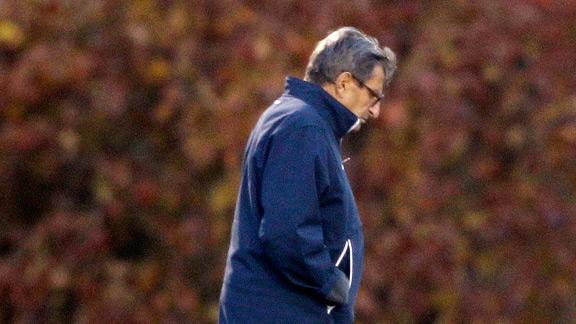
Joe Paterno: a lion in winter?
Joe Paterno, the winningest football coach in history, has been fired, along with the president, a vice president, and athletic director of the school. More may follow. What was once a storied career at a storied university's epic football program has come to an ignominious end.

A longtime assistant coach, Jerry Sandusky, who had retired in 1999, has been arrested on charges that would make him a serial child molester. On at least two occasions, he had been caught in the act on the Penn State campus having sex with young boys. On one of those occasions, in 2002, Joe Paterno was told by a young graduate assistant that he had witnessed Sandusky sodomizing a 10-year-old boy in the showers.

Though Paterno told higher-ups, he failed -- as obligated as a mandated reporter -- to inform the police. So did everyone else in the chain of command, right up to the then and current president, Graham Spanier. Now they're all gone. [Correction: Joe Paterno was not legally required to report to the police, only to his superiors. I regret the error.]

Good, but maybe not good enough. Time will tell. But as an American, and a man, as everyone in this dark failure was, I feel humiliated. This is not about me, but only about my reaction. It just hurts to be once again reminded of the depths to which we can sink and the variety of ways we can fail to live up to simple common decency.

Polanski
I was a great fan of Roman Polanski and his movies. Chinatown is on my list of the greatest movies of all time. I knew somewhat of his "escapade" with a 13-year-old model and subsequent escape to Europe. And during his long and continuing exile, I was ambivalent until I heard Calvin Trillin's couplet in honor of Polanski's crime:
Why make him out to be Darth Vader, For sodomizing one eighth grader?
Put that way, I understood Polanski should have paid dearly for his crime. He has not.

Sex is a hard topic to grapple with. It is not, however, when children are involved. This makes Joe Paterno and the rest of the players in Penn State's tragedy all the more culpable for their failure to act. Some have been charged, others not. If the rest don't get brought up on charges they're lucky. If they are, even Paterno, it's as it should be.

To clarify: This is not a tragedy for Penn State. This is a tragedy for the victims and their families. For now, Penn State and its football program can go to Hell.

We would all hope this might be the last of this kind of tragedy. We all know it will not.
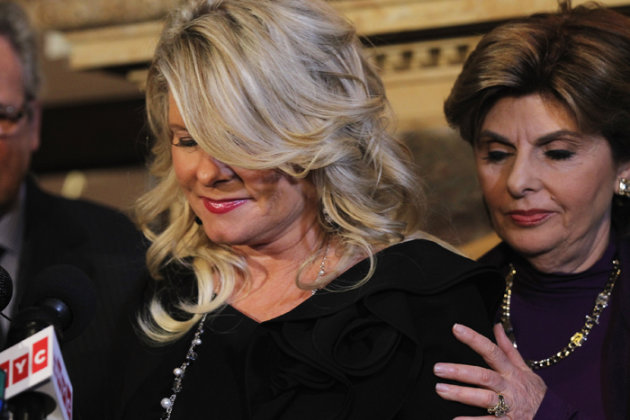

An unwilling underwriter of Herman Cain's fifteen minutes
In light of the above, Herman Cain's troubles are mild. At Penn State, we had monsters, criminals, and derelicts. Cain, were he in a Shakespeare play, and a comedy at that, he would be playing a fool, like Bottom, Touchstone, or Dromio.

This is not to make light of his offenses against who knows yet how many women -- and still not clear the extent of which -- but his sorry story is likely to play out more as a farce than a tragedy. So, even to give him another fifteen minutes of fame is a waste of klieg lights. He's a pizza mogul and a restaurant lobbyist and apparently a crude and clumsy bungler when it comes to dealing with women. Whatever else he might be, he's not a credible candidate for president. Please, Herman, go away.


I'll wreck the country as soon as I remember how...
Rick Perry's epic fail in last night's CNBC debate in Michigan earns him, for the first time from me, a bit of pity. Watching him unable to name the third of three agencies of the federal government that he would close upon becoming president, I was struck by how human he looked.

I once was invited to sing a song at a funeral of an acquaintance's mother. When my moment at the somber event came, I stumbled over the words and forgot a good part of them. That I'd written the song in question made my failure all the more vexing. To this day, when I recall the incident, I feel its sting.

I disagree vehemently with Rick Perry's ideology and views on almost every topic, on almost every level. But, for a moment, his human frailties, at least one of which I share, made me feel sympathy.

Juan Cole, in his post of the Perry slip, makes a darker, more resonant observation:
Me, I think it was a bad conscience that produced the gaffe. Perry is in the back pocket of Big Oil, which is on the verge of making our planet if not uninhabitable then at least extremely dangerous for human beings. If the nations of the world don’t get serious about curbing carbon emissions immediately, then by 2017 the chance to keep warming to 2 degrees C. will be lost altogether. Likely the world is head for a 5 degree C. increase over the next couple of centuries, and within a few centuries there will be no land ice and sea levels will rise 10-20 meters/ yards for every degree C. of increased temperature.
Perry knows that he is advocating abolition of the Department of Energy for pure greed, and that his politics threaten the lives of his grandchildren (and of the grandchildren of us all) and deep down inside is embarrassed by his motivation. Hence, the suppression of that memory.
 Cole makes a cogent observation. As I watch, day after day, what the Republican leaders of this country articulate should be the policies of this country -- which the dutiful presidential candidates then mouth -- I can only take them for what they portray: cynical, craven acts in a dumbshow meant to guarantee that the wealthy elite, and only the wealthy elite, reap the profits, while allowing their Republican lackeys at least a little taste.

Now that's a keen trick: turning a farce into a tragedy.

Letting the capital markets work their magic

Tuesday, November 8, 2011

Workers' Rights Are Human Rights

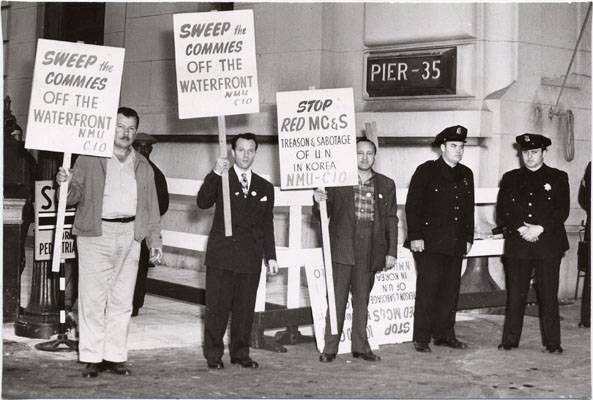
Backlash against unions during the "red scare."
Today in Ohio, voters are going to the polls to vote on whether to roll back Senate Bill 5, passed under the tutelage of Republican Ohio governor John Kasich, that trimmed public workers' rights, so that they would no longer be able to negotiate either benefits or pensions. In this Kasich was emulating Wisconsin governor Scott Wilson, who is himself a subject of voter anger and an ongoing recall campaign.

The referendum has polled well and looks to be supported by a strong majority of Ohio citizens. Let's hope so. Limiting what union members can negotiate to wages only distorts the meaning of both negotiations and benefits. Benefits and defined pensions are wages, pure and simple. In the case of public employees, strong unions that negotiate good benefits and trustworthy pension plans are the reasons why many people choose to work in the public sector where salaries are often lower than what they'd receive in the private sector with comparable education and experience.

I should know. It's one reason I chose to have a late-in-life career as a teacher. The other was, well, I wanted to teach and serve.

Regardless of how it turns out in Ohio today, the message here is that unions have been good for America and the world. The labor movement, along with the progressive drive for workplace, food, and drug safety, has led to some of the biggest improvements in the history of the world. In the long progression from savagery to slavery to feudalism to capitalism to societies governed by the rule of law established by the people, workers' rights have played a vital role.

Workers' rights do more than guarantee a living wage and safe working conditions: they guarantee basic human dignity.

Tell me this:

Who would like to undo work rules protecting children in the workplace?
Who would like to undo workplace safety rules?
Who would like to undo rules concerning hours, breaks, overtime, and the right to have meals on a regular basis?
Who would like to have no set minimum wage?
Who would like workers to have no ability to work together to achieve wage and benefit goals and workplace rules but rather to have to negotiate all terms on an individual basis, often with huge multinational corporations?

Hopefully, very few would like to see a rollback to the days when workers were at the mercy of the moneyed class. If you look at the above list and find that you support the vast majority of the rights enumerated, then you already agree that these rights are vital and thus belong in the category of human rights.

Yes, we could quibble about certain things, such as whether minimum wages are good for business or not, or whether modern corporations -- many of which are richer and better capitalized than at any time in their history -- can afford to offer guaranteed pensions to their workers, but that doesn't mean that workers don't deserve basic guarantees of a living wage, a safe workplace, and essential human dignity.

The pursuit of happiness
If you agree, then you believe that workers' rights are human rights. All that's left is to set and maintain standards to guarantee these rights.

I fall on the side of the workers, who are the vast majority of human beings. If you are not on that side, whose side are you on? And if you are on a different side, in what way would guaranteeing broad workers' rights not be in your best interests?

Disenfranchising workers leads to uneducated, unhealthy, impoverished lower and middle classes. It is in the best interests of all that every level of society be supported on its way to a healthier, better educated, more capable, and sustainable future. Americans originally called these "unalienable rights" and expressed them as "the right to Life, Liberty, and the pursuit of Happiness." What part of that enduring expression of what is essentially American -- and human -- precludes the inclusion of workers' rights in the company of human rights?

Sunday, November 6, 2011

Wrapping Our Heads Around Reality

I never did it, and I'll never do it again.
 
A few columns caught my fancy this weekend, and they all have to do with reality, as in being in touch with. I know, it can sound pretty arrogant to suggest I'm in touch, but you're not. So that's not what I'm saying.

If I have a standard complaint about the conservative side of our societal spectrum, it's that conservatives thrive on a good deal of denial. Case in point: Herman Cain.

So, to column one: Dahlia Lithwick's stark assessment about the conservative take on Herman Cain's sexual harassment travails. The party of family values doesn't have a problem with Herman Cain for what at first seems like a contradiction: for the conservatives, there's no there there. Since there is no such thing as sexual harassment, Herman Cain must be innocent.

My initial prediction was only slightly different: since the conservatives believe in the authoritarian father figure model, the rightful place of the woman in the family is subservient to the father. Thus, in a very religious sense, women should defer to men.

Dahlia's take is close: conservatives view women who sue men for sexual harassment as litigious, money-grubbing sluts. Anyway, read it for yourself. Also, too, read the Amanda Marcotte piece on it, also at Slate.com.

By the way, my thoughts -- and Lithwick's and Marcotte's as well -- have nothing to do with Herman Cain the candidate. He's unqualified in a Sarah Palin sort of way and won't get nominated. He's actually on a book tour and accidentally morphed. Oh well.

How many of these do we have in the U.S.? In India? In China?

Column two that caught my eye was by Juan Cole, the Middle-East expert from the University of Michigan, who popped off a post at his Informed Comment blog that was, a surprise, about the huge spike in carbon dioxide being pushed into the atmosphere. Apparently, 2010 marked a significant 6% spike in carbon dioxide emissions, totaling 512 million metric tons, an amount not seen for about 50 million years.

My initial reaction was, how are the climate-change deniers going to deal with this? Then it hit me: they don't have to do or say anything. Facts have no meaning when you're already in denial. They can just say that it's the usual distortion of the truth by the ivory-tower elites at the universities and the liberal media with their anti-business agenda.

Solar energy is for sissies. Drill, baby, drill!

Then I saw Paul Krugman's article about solar power and how it's getting so cheap that we may be reaching a tipping point where it might just cost the same as coal, especially when you factor in the cost of coal in pollution and the health problems it causes. Again, rather than this being good news for the whole world, it's just more liberal clap-trap aimed at harming U.S. business interests. It's just more job-killing liberal do-good-ism. Down with Solyndra, and drill, baby, drill!

Give a girl a break. Marriage is hard!

News article three that capped my week of what-the-hell came from New York Times' op-ed writer Frank Bruni. He laid out for all to comprehend how, between Kim Kardashian, Herman Cain, Jon Corzine, and the Greek tragedy, reality has morphed into, well, reality, but one too far from what it is commonly understood to be, somewhat of a FUBAR reality.

As I wrote this, another example of reality gone mad is current discussions on raising the Medicare age from 65 to 67. It's a favored method for reining in federal spending, especially among the Republican presidential candidates and the Republican leadership in Congress. Even Barack Obama and other centrist Democrats are warm to the idea.

The trouble is that all reasonable studies of the subject show that by raising the age from 65 to 67, we actually raise the overall costs of healthcare for ALL Americans. Oddly, there is an exception. Those in the 65-67 cohort would likely save money because their employers, if they're working, would have to continue to offer them healthcare benefits, and if they're retired or poor, they'll likely qualify for Medicaid or other healthcare assistance programs.

I love me some Medicare savings.

You see, because the 65-67 cohort are the healthiest in the current Medicare system, they actually keep rates down. Once they're booted out, those remaining on Medicare will see their rates go up. So reason and reality would dictate that we not raise the Medicare eligibility age. But we likely will because, well, we got to do something!

To recap: Kim Kardashian really did get married to Kris Humphries only to file for divorce 72 days later, while really making millions of dollars doing it; Herman Cain was really forgiven by most conservatives because sexual harassment isn't really what you think it is; Jon Corzine really did tank his company, MF Global, by overspeculating in European debt and likely participated in crimes while doing it; the Euro-bosses of the EU, Germany and France continue to bully Greece with austerity measures, actually sending the Greek in an economic death spiral that could have been predicted -- and was -- even though it's not in Europe's or the West's interests to do so; and the U.S. is probably going to raise the eligibility age for Medicare even though it's actually going to increase, not decrease, overall costs to society.

Back in 2002, author Ron Suskind had a conversation with a senior Bush aide who famously told him:
“That’s not the way the world really works anymore,” the Bush aide told the journalist. “We’re an empire now, and when we act, we create our own reality. And while you’re studying that reality – judiciously, as you will – we’ll act again, creating other new realities, which you can study too, and that’s how things will sort out. We’re history’s actors … and you, all of you, will be left to study what we do.”
 How'd that work out, huh?

No, we've got some considerable amount of work to do where reality is concerned. Starting now, I'm actually going to work really hard to restore some sanity. All joking aside, it's why I write this blog.

After I'm done with MF Global, maybe I can have a reality show. Trump has one!

Update: Herman Cain's poll numbers are dropping and a new accuser is planning a press conference. Holy crap, her lawyer is Gloria Allred. Reality bites! Jon Corzine is getting lawyered up. And Kim Kardashian is, well, still famous for being famous.

Update 2: The Cain scandal is entering what Josh Marshall of TPM calls the "Gloria Allred phase" with, well, watch the video:


I guess we're inching up to reality after all.

Thursday, November 3, 2011

Occupy Oakland Heads for a Flame Out -- (Good) Updates


As I write this, the Occupy Oakland movement has reoccupied Frank Ogawa Plaza downtown and shut down the port of Oakland. A handful of anarchists in the Plaza area have stirred up confrontations with police, mostly over petty -- but aggravating -- vandalism, such as garbage fires, graffiti, and broken windows. This sort of thing mounts up, and eventually the police will have to shut it down, citing safety concerns.

The port presents a similar problem with a similar outcome. Some trucker or longshoreman is going to get hurt -- there's already a confrontation between a Mercedes driver and the crowd on the street, leading to two injured pedestrians -- and the police will step in. There was a bad scene at the port back in 2003 that injured a number of protestors and led to a number of payouts totaling millions, so the police are going to tread carefully. But that doesn't mean there isn't a chance this will end badly. I hope it doesn't.

In the aftermath, there will be a lot of analysis of what went wrong. There may be some opportunity to say that the Occupiers got their message out, and the movement had valid complaints, frustrations, etc. We'll see.

But what's important for me is that I remind the Occupy movement, the 99%ers, or whatever we're going to call it, that there are key issues and goals we can all agree on:
  1. Ending the Bush tax cuts exemplifies the positive outcomes that this movement should aspire to. Read James Kwak's view about this in the Atlantic.
  2. Go for positive change by building bridges with labor. Shutting down the port of Oakland is a step in the right direction in terms of old-style labor actions. A new, more positive action would be to fight for the card check bill (by reading the Chamber's screed against it, you can see why it's good!). It's currently dead, but could be revived. Or we could target the oppressive 1%ers like Wal-Mart. Organize Wal-Mart workers!
  3. Support a coherent Move-Your-Money movement, away from big banks to credit unions and regional or local banks. Make a statement with your bank statement.
  4. Support public-sector employment. It's a huge source of job loss in the nation over the last year. Write/email your congresspersons in support of Obama's jobs bills, especially the one that targeted teachers, firemen, and police.
  5. Bring back estate taxes and capital gains taxes. This is where the 1% produce their wealth. Also, tax stock options and hedge-fund loopholes. That's where the CEOs and fund managers escape taxation.
Okay, enough. But these actions are real and lead to real reform. We need a strong Volcker Rule, a Dodd-Frank set of regulations with teeth, and empowered consumer advocates like Elizabeth Warren.

One thing I try to remember: income inequality was very high just before the Great Depression. It's very high now, leading up to the Great Recession. We lessened in greatly over a half-century. We can do it again in much the same way. Occupy your mind with that, and get to work.

Update. Oakland police did start moving in to disperse the troublemakers in masks and bandanas in the early morning hours. Fortunately the police have made a distinction between the anarchists downtown and the peaceful protestors down at the port. For now, that's good thing. Still, it's hard to see how this winds down peacefully.

Peaceful marchers head to the Port of Oakland
Update 2: The occupation of the port ends peacefully.

Update 3: Occupy Oakland is inspiring?

Tuesday, November 1, 2011

Bellagio on the East River, MGM Grand on the Mall

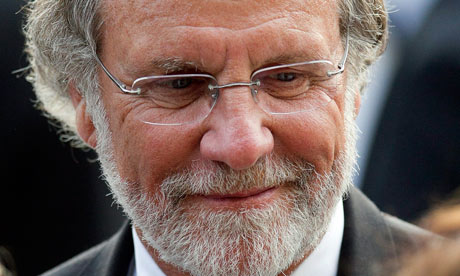
Jon Corzine, deck chairs coordinator
Goldman Sachs has had some distinguished alumni, and a string of them have figured how to soil their own nests. The latest, former Goldman CEO Jon Corzine, has taken the wisdom he acquired at G Sachs and applied his best casino moves at his new joint, MF Global Holdings Ltd., where he's the current CEO. MF Global just declared bankruptcy yesterday after 18 months of Corzine at the helm.

It's not like Corzine hadn't read the book before trying to make the movie. Previous musical-chair maestro from Goldman, former Treasury Secretary Robert Rubin, took his talents after-government service to CitiGroup, where he schooled them on the wonders of sub-prime loans during a housing bubble, just in time for the 2008 weenie roast that just about burned down the house. Props for nerves of steel! God bless the taxpayers! Go Fed!

They might not let me do this again...Just kidding!!
This kind of performance, where you go someplace -- like Citigroup -- and break all their toys and smash all their pretty shiny things, gets you, if you're Robert Rubin, oh, say, $126 million in compensation.

(An aside: Was this the same Robert Rubin that supported the repeal of Glass-Steagal while at Treasury during the Clinton era? You know the law that likely would have prevented the 2008 financial collapse were it still in place? Yeah, that Robert Rubin...)

It's not like he didn't do some interesting things while at CitiGroup: Rubin's tenure as CEO and special director for "strategic managerial and operational matters" was marked by a 70% drop in CitiGroup's stock price. Oddly, this qualified Rubin to become an economic adviser to the newly elected Barack Obama. It's all in the family.

So our dear Jon Corzine, fresh off a stint as governor of New Jersey, saw in MF Global a chance to get some skin back in the game. Betting big on European debt made sense. Why not bet the farm on Greece, Portugal, Italy, and Ireland bonds? Surely they'd get bailed out too if they went south. That's what central banks do, for chrissake.

Would MF Global be part of that Non-Bank Private Sector debt? Ya think? Ooooh...


Last week, we found out it's not what the European Central Bank does. So MF Global's clients said, "gee, we gotta go!" Oops.

The only thing left is to see how much of Jon Corzine's golden parachute he gets to keep. Hopefully only the pull chord, a couple of thousand feet above the East River. But hell, that never happens, does it? Not in the ole boys club. If he doesn't end up back in government he can always join a think tank, just in time to plan the next meltdown.

Fun fact: The CEO (or Senior Partner, as they called them then) of Goldman Sachs was none other than Hank Paulson, later to come to prominence as Treasury Secretary under George W. Bush. Paulson oversaw the housing bubble POP and was a principal architect of TARP.

Another fun fact, courtesy Wikipedia:
On December 4, 1928, it [Goldman Sachs] launched the Goldman Sachs Trading Corp. a closed-end fund. The fund failed as a result of the Stock Market Crash of 1929, hurting the firm's reputation for several years afterward.
Pick yourself up, dust yourself off, and start all over again!

Update:  MF Global Holdings Ltd. has entered the world of real hurt as sources within the company have confessed to using client's money to shore up the company's own funds, a big no-no in the futures market. Who knows where this leaves Jon Corzine. If precedent holds, he'll turn out to be "out of the loop."

At this point, we might as well mention that Robert Rubin "sparked controversy in 2001 when he contacted an acquaintance at the U.S. Treasury Department and asked if the department could convince bond-rating agencies not to downgrade the corporate debt of Enron, a debtor of Citigroup. The Treasury official refused." (Courtesy Wikipedia)

Pick yourself up, dust yourself off, and avoid jail all over again!

Monday, October 31, 2011

I'll Listen to Your Offer, but First Tell Me How You're Going to Screw Me

Michael Lewis
I'm too lazy to look up who said that to whom, but it was from an article at Portfolio.com by Michael Lewis. The context was a trader on Wall Street wanting to sell another perhaps savvier trader a product, and that savvier trader wanting to get to the nub of the offer. "First tell me how you're going to screw me," the savvy one asked; "I don't know what you mean," replied the first trader. "Then we can't do business," countered the savvy one, getting up to go. So the first trader gives in and tells the savvy one how he was going to screw him, after which the savvy one sits back down. He can deal with a truth teller.

I loved the exchange because I could never have been that gutsy, which is why I'm more gullible than many other people who get into the markets. The Lewis article entitled "The End" is still available here. Three years ago when I first read it was the moment in time when I began to understand how screwed we were and why. Around that time TARP was enacted, and the great unraveling was well underway.

Now, today, I read a blog post from Brad DeLong that is equally enlightening. Read it. Here's the nitty-gritty:
There are three ways in which a financial transaction can be a good deal for both sides.
First, people have different time preferences: I have money now that I do not want to spend on some useful commodity until sometime in the future, while you may have no money now and need some but anticipate being flush in the future; then we both benefit if I lend you the money--at interest. Second, risks distributed and diversified are risks dissipated, and so even though the average customer pays money into the insurance system insurance is still a valuable thing to buy because the insurance company pays you when you really need the cash. Third, economies work best when benefits and losses run with decsion-making: those whose actions create or destroy value pay attention when they have "skin in the game", and financial transactions are a good way to make sure they have that "skin in the game".
Those three sources of value for both sides in financial transactions are powerful.
They motivate net investments and drawdowns, insurance and diversification, and the creation of equity interests for managers, partners, homeowners, and others.
They drive perhaps 1/1000 of the transactions we see on financial markets each day.
All the other transactions are driven by two different factors:
First, in some transactions one or both sides are simply swept up in the excitement of the game. Second, in many transactions one or both sides has simply gotten the odds wrong, and they do not understand what they are doing.
Many economists these days talk about trade in financial assets as being motivated by "disagreement": I think I can make money by doing X, you think you can make money by doing Y, because we disagree about how the world works both X and Y are compatible, and so we trade and we both go away happy--until time passes, uncertainty is resolved, and I learn that you were right and I was an idiot.
UC Berkeley's Brad DeLong
  This is the best advice a potential investor -- or voter -- can receive. Both Michael Lewis and Brad DeLong, in turn, are telling us something very useful. When you listen to financial advisers, insurance salesmen, or political candidates, you should keep the phrase "How are you going screw me?" in mind.

Wouldn't it be wonderful if, when Rick Perry appeared on Meet the Press, David Gregory asked, "Governor, before we go on, could you tell us who's really going to get screwed by your 20% flat tax plan?" And when Perry answered, "Why, no one gets screwed," Gregory would then say, "Sorry, Governor, looks like we've got nothing more to discuss. Good luck with your campaign."

Hey David, this is not what I meant, you know?
And to be fair, let's imagine President Obama getting the same treatment over his desire to close corporate loopholes and raise the marginal tax rates on the wealthiest individuals. Wouldn't it be wonderful to hear him say, "Well, David, I suppose you could say that my plan screws the rich. Fair enough. But that's a feature, not a bug. And two of the richest people in the world, Warren Buffett and Bill Gates, have agreed with me. They like my plan."

Wait. That's just what Barack Obama has been saying all along. Rick Perry with his 20% flat tax and Herman Cain with his 999 plan always have to bob and weave when it comes to who's getting screwed. The same goes for Paul Ryan and his budget plan. He bobs and weaves when it comes to admitting his plan screws seniors. The closest he comes to admitting it is when he promises the current seniors that they are safe. His plan only screws future seniors, a fact he's loathe to admit.

No wonder these guys don't mind paying a little extra...
So here's my advice: when we listen to anyone who wants our money, or wants to cut our benefits, or raise our taxes -- or lower them for some, for that matter -- try to listen to find out who's getting screwed. If you can't figure it out, don't just gut-react with a "I trust conservatives," or "I believe Obama." Research until you are satisfied that you've got the closest to a complete answer, an answer that encompasses more than just your own self-interests. If that means your taxes are going to go up but you'll get value for your investment, then fine. And if it means your taxes will go down but our country will fall apart or go broke, then resist it. Figure out what's best and fight for it.

Herman Cain Has Gone Viral, and the Republican Party Has Caught Pneumonia


Funny thing is, Herman Cain's troubles are bigger than a sexual harassment scandal. Sure, if it turns out that these charges don't "stick" -- which is odd because I think I can almost guarantee that they'll never be "proven" -- then Cain can eventually be a good, solid conservative "victim" of the liberal media (?) and get a job at Fox.

But his problems are bigger than these charges. His problem, I've always felt, was that he was essentially -- and I do mean in the true sense of that word -- unserious. No, not in the way hippies are punched for being "unserious" by the Beltway Villagers, the Very Serious People that control the centers of power, but rather in that he was making it up as he went along, and his speaking skills and presence gave him more traction than his ideas deserved.


And so Herman Cain's probably short-lived success has debased the very party he contrived to lead. Andrew Sullivan is not well-regarded in a lot of liberal blogging circles, but I have always relied on him as a gauge of the intellectual right. And if we lend David Frum that kind of credence, then that's two leading conservatives that recognize the silliness if not the batshit craziness of the current Republican canon.