Monday, November 21, 2011

Big Lie #2: We Believe in Liberty

We don't believe in liberty. We believe that peace and freedom comes at the barrel of a gun. We may believe in free capital markets (something we should not), but we don't believe in the free market of ideas.

If we did, we wouldn't crack down so heavily on protesters, most especially non-violent ones. Let's go to the video. As you watch, ask if this is your America.

UC Davis last Friday:


Here's UC Davis Chancellor Katehi walking to her car:


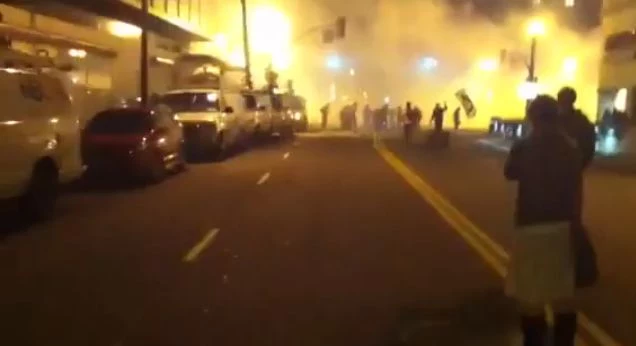
Seattle last week:

  
Cops beat Iraq War veteran Kayvan Sabehgi at Oakland last month:


The same police action:


The Big Lies and the People Who Believe Them

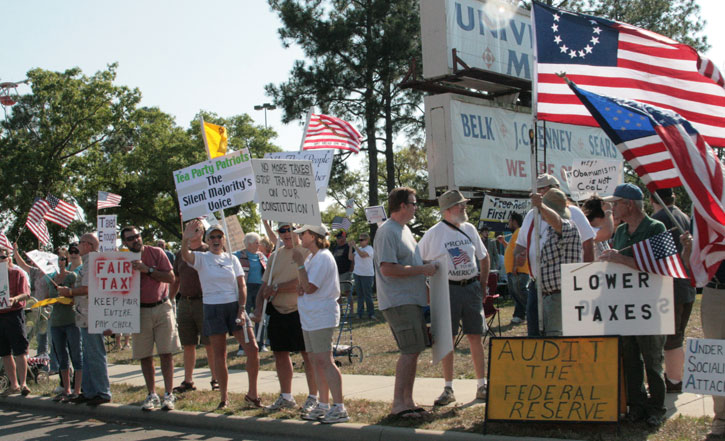
Tea Partiers: Headed for the 1%? Not on your life.
First and foremost point: don't be one of them, the people who believe the big lies. The big lies are the product of media narratives supported by willful ignorance. They are not the product of conspiracies, except perhaps to the extent that secret money funneled by political operatives from fabulously wealthy individuals is used to manipulate the ignorant and easily misled. Don't be one of the misled.

I was going to write first today about the Occupy Movement and the police state that it has revealed, and I will. But what captured my imagination today was a Huffington Post blog by Jeffrey Sachs, a professor of economics at Columbia University. He framed our reality in a profound way. There is a Big Lie -- that we can't afford to raise taxes on the rich -- that is supported "gleefully" by the Republicans and "sheepishly" by the Democrats. How true. He adds:
The key to understanding the U.S. economy is to understand that we have two economies, not one. The economy of rich Americans is booming. Salaries are high. Profits are soaring. Luxury brands and upscale restaurants are packed. There is no recession.
The economy of the middle class and poor is in crisis. Poverty and near-poverty are spreading. Unemployment is rampant. Household incomes have been falling sharply. Millions of discouraged workers have dropped out of the labor force entirely. The poor work at minimum wages to provide services for the rich.
There are two forces that account for this deep divide. The first is globalization. Manufacturing employment peaked in 1979, with jobs and factories increasingly shifting overseas. For a while, the housing bubble provided construction jobs that partly offset the loss of manufacturing jobs. Now the housing bubble has burst. Good jobs for young people with a high-school diploma or less have disappeared.
 Sachs goes on to say that an important aspect of the Big Lie is that we'd be worse off if we were more like Europe, with its high taxes. Where the taxes are highest, northern Europe, the economies are sound and in fact in most every way superior to ours:
The lowest macroeconomic misery is in Northern Europe. Norway has the lowest score, followed by Switzerland, Luxembourg, Netherlands, Sweden, Germany, and Demark. All seven countries have lower unemployment rates, smaller budget deficits as a share of GDP, and lower foreign deficits as a share of GDP, than the U.S. We look pretty miserable indeed by comparison.
VW factory in Dresden, Germany


 I had the pleasure of living most of a year in the Netherlands in 1971-72, and the experience made me aware of how much more civilized Northern Europe is compared with the U.S.  Things have only gotten worse in the U.S. in the four decades since. It's not an accident. Our priorities are all out of whack.

So, to simplify: the Big Lie is just that. The Republicans under Reagan and George W. Bush forced massive tax decreases on the rich -- W.'s father famously raised them, modestly, and Bill Clinton raised them, more substantially, leading to a period of enormous growth and government surpluses by 2000 -- and the result is the rich are richer and the poor are poorer. The rich keep more of their money, and it doesn't trickle down. If it did, we'd know by now.


Big Lie #1, then, is we can't tax the rich more. The fact is we can, and we must. If you're falling for the media narrative that the Occupy Movement doesn't have any goals, don't fall for it any more. The 99%-ers want the rich to pay more. So do I, and so should us all, including the rich, who would also benefit.

Who believes the Big Lie? The people who expect someday to be among the 1%. Why is it foolish to believe that we'll get there? Because so very few do. How many of us will? About 1%. Pretty bad odds. Don't play the game. Don't believe the Lie. Vote your circumstances, not your dreams. If your dreams come true, so much the better. In the meantime, work to restore balance to our society. Our future depends on it.

Friday, November 18, 2011

Why Our System Is Broken: Media Narratives

We can break our society into pieces, not like the "estates of the realm" as in the Middle Ages -- the clergy, the nobility, the commoners -- but into well established sectors. We've got the public sector, comprised of government and its related functions, the private sector, which constitutes most of private enterprise, and the media, which can be both public and private, obliged to report current events and document history.

I no longer think of religion as a sector of society. In the American system, religion does not belong in the public sector; therefore its home is in the private sector, even if its special tax status sets it apart.

In any event, the role of the media, especially in a media-centric world, is vital. That's why our founding fathers put freedom of the press alongside freedom of speech and religion among our first guaranteed rights.

Now, I've studied enough history to know that the press has not always been sacrosanct and safe from the scourge of error or misguided opinion. I understand the vitriol that was thrown back and forth in the press during the political battles in early America was of such a nature that we would blanch if subjected to it today. Current TV political ads do stoop quite low, but they are not technically media in the sense of journalism.

But something has gone very much wrong with our media today, and until we fix it we will suffer from it. What's wrong with the media today stems, at best, from a misconception: that the media needs to be impartial. It also suffers from just what impartiality means.

Here might be a good example. If a man shoots a cop while trying to escape capture in the aftermath of a crime, it's fair to report that "witnesses said they saw the suspect emerge from the car guns blazing. The police officer appeared to be hit several times by that first barrage." It would not be proper to continue to say "witnesses were unclear on whether the officer made any attempt to duck or whether he 'had it coming'," you know, just to provide balance.

Unfortunately, that how a lot of our reporting, especially political reporting is managed today. And I do mean "managed."

Where it's most grating is in the reporting of political processes in which one side is clearly engaging in obstruction, while the other is attempting to fulfill a policy that has broad support. For example, it's clear that the Republican members of the deficit-reduction so-called Super Committee are not proceeding in good faith when they raise some taxes (finally) while cutting enough taxes for a net loss of revenue, and then still call for substantial cuts in social programs. It's also clear that the Democrats have signaled a willingness to cut spending on social programs AND raise taxes to reach deficit reduction goals.

That's essentially what's been happening. But to hear the media reports, it's a "both sides have been unable to come to any meaningful compromise that would satisfy the majority of Americans who reside in the middle of the American politique."

We hear this even though the Democratic deficit-reduction plan is actually a centrist position. What's more, polls routinely point out that strong majorities favor this position.

Another current maddening example is that the Occupy Movement has no leaders and no explicit goals or principles and thus can't bring meaningful change. While it's true that no strong leaders in the movement have emerged, it's absolutely clear that Occupiers have a very clear principles and goals: they are unhappy that the wealthiest 1% of Americans control 40% of our country's wealth. The 99%ers are unhappy that the banks are foreclosing on thousands and thousands of homes to a great extent because they made it too easy to borrow money. A good solution would be to make it easier to pay back these loans. Everybody wins: banks make some money, and people keep their houses.

I could go on, but I think you get the point. We all know what the 99%ers want, and a lot of us want that, too. Even the tea partiers, whose inchoate message was eventually amplified by astro-turf organizations and their money, would and should agree with a lot of the message of the Occupy Movement.

Here's another example of the damage media narratives do. If the NYPD says that they worried about public safety, and that's why they're going to shut down the camps, well, the media just dutifully reports it. If a media outlet can cobble together a handful of reports that support the idea that the Occupy Movement has turned violent, then that's what you'll hear: endless reports of a fight here and knife drawn there, and murder that took place near an encampment, no matter whether it's eventually shown to be unrelated to the movement or its adherents. When the media ordains a narrative, it's hard to get them off it. This is how editorial directors gets so much power. If Bill Keller thinks the OWS folks are dirty hippies, they'll be dirty hippies, as if that's a bad thing.

Here's Paul Krugman:
Right now, the campaign against OWS basically tries to get working Americans to turn on the movement, even though most people support the movement’s goals, by trying to make it seem as if the protestors are people not like you — whereas the plutocrats are. Hey, this has worked many times in the past; that’s the whole point of “What’s the matter with Kansas.” And it can operate in many directions: OWS should be shunned because they’re dirty hippies, Elizabeth Warren is not-like-you because, horrors, she’s a Harvard professor.
 Pretty much. And Glenn Greenwald:
As Stelter correctly noted: “Much of what is said on television about the Occupy Wall Street movement is opinion. Some is factual. And sometimes, it’s hard to tell the difference.” That is at least part of the reason that public opinion is souring on the movement. But as usual, the problem isn’t that people are watching falsehoods from Fox. The problem is that so much of what Fox spouts is also found — often first — in The New York Times.
 Yep.

I don't doubt that the media creates narratives as a tool to package stories in order to organize the story for its listenership, readership, or viewership. In that, I'm sure they often mean well (exception that proves the rule: Fox News). The problem is that narrative creation and management are so open to manipulation, and even well-intentioned editors can create narratives that are counterproductive to the service they wish to provide.

What's painfully true is that these narratives can go off the rails. The run-up to the Iraq War is a case in point. You don't need me to remind you of how that worked. Another painful example: the "Mission Accomplished" debacle with Bush on an aircraft carrier was accompanied by a narrative that this cowboy deserved his swagger because he "looked at home in a flight suit." Everyone was too enamored of the narrative to ask the question, "What mission was accomplished?" We all too soon found out. Thousands of lives later and nothing has been accomplished for certain.

To wrap this up: This quest for fairness in the media has caused a portion of viewers, listeners, and readers to issue knee-jerk reactions, such as "THAT REPORT WAS BIASED. THE NEWS IS SUPPOSED TO BE BALANCED. LIBERAL MEDIA AT ITS WORST@!!" Unfortunately, consumers these days mistake reporting for opinion and vice versa. And we have the media to blame for that.

If the Republicans are full-bore obstructionists, report that. If Democrats are milk-toast negotiators that reveal their hole cards right at the beginning and thus always end up losing, then report that. If the result of that is going to be another defeat for Obama, then report that.

If the cops start busting heads at an otherwise peaceful demonstration or occupation, report that. Don't report that "Mayor Bloomberg has finally lost patience with the demonstrators and has, in spite of his respect for free speech and right to peacefully assemble, decided for public safety's sake to clear the park." Especially don't say that if, in fact, he sends in police in riot gear with pepper spray in hand and truncheon on the belt ready to bust heads in the middle of the night while cordoning off an area of New York as a "no press zone." That shows no respect for the First Amendment whatsoever.

What you can do:
  • Watch carefully for the narrative and see how it's forming. Test the narrative and its various components. If the facts don't bear out the conclusions upon which the narrative rests, ditch the whole thing and compose your own narrative.
  • Accept that reporting can express facts and draw conclusions. A sentence like "The Republicans continue to resist all efforts to raise taxes as part of any package and have, in effect, shut down the entire process, leading many observers to voice concerns that chances of any solution are slim to none," actually is reporting that includes a logical conclusion drawn from observable facts. It's not opinion foisted on us by the "lamestream media."
  • Accept opinion for what it is. I don't care for David Brooks, but he is an opinion writer and thus has a right to free expression. Wise men accept this with grace (okay, I occasionally swear at him when he's on the TV) and don't confuse reasoned opinion with the kind of wild distortion of facts as practiced by professional bamboozlers like Glenn Beck, Bill O'Reilly, Sean Hannity, and Rush Limbaugh. Their stock-in-trade is truth distortion. Without it, their whole jig would be up.
  • Educate yourself. If you hear that the Fed is going to enact QE3, find out what that means. Figure out if it's fiscal or monetary policy at work. Find out if it makes good sense to you. Become knowledgeable about the things that will help our society work better. The Internet is, obviously, a great place for this research. Start by reading the economics blogs listed on the right sidebar of my blog.
 As an example of educating oneself, I offer a page on the Internet I found at a site called Rhetorica.net on media and political bias. Read the whole thing (not long), but here's a tease:
Narrative bias: The news media cover the news in terms of "stories" that must have a beginning, middle, and end--in other words, a plot with antagonists and protagonists. Much of what happens in our world, however, is ambiguous. The news media apply a narrative structure to ambiguous events suggesting that these events are easily understood and have clear cause-and-effect relationships. Good storytelling requires drama, and so this bias often leads journalists to add, or seek out, drama for the sake of drama. Controversy creates drama. Journalists often seek out the opinions of competing experts or officials in order to present conflict between two sides of an issue (sometimes referred to as the authority-disorder bias). Lastly, narrative bias leads many journalists to create, and then hang on to, master narratives--set story lines with set characters who act in set ways. Once a master narrative has been set, it is very difficult to get journalists to see that their narrative is simply one way, and not necessarily the correct or best way, of viewing people and events.
 Rhetorica is the site of Dr. Andrew R. Cline, Assistant Professor of Journalism at Missouri State University.

 Update. Dan Beucke of BusinessWeek actually offered what I view as a balanced analysis of OWS so far. Check it out.

Wednesday, November 16, 2011

Education Is An (Optional) Human Right


Any civilized nation must provide a free, quality education. I believe that should go all the way to the 16th grade, to a bachelor's degree.

Here is the nub: to what point should an education be mandatory? If one does not want to be educated, to what extent should one be forced?

Here in California it's mandatory to attend school -- or an equivalent, such as home schooling -- between the ages of 6 and 18, unless one has reached the age of 16 and has "graduated from high school or passed the California High School Proficiency Exam (CHSPE) and obtained parental permission to leave." (California Education Code)

All states follow roughly the same practices, though most end mandatory attendance at 16. Colorado was late to the party, apparently having no law concerning mandatory school attendance until 2006.

A quick look at laws in Europe and Asia confirm that all countries have compulsory education from roughly 5-7 until 14-18, corresponding to something like our high-school level. Mexico is a low-end example, requiring schooling only through the 9th grade, or the end of junior high.

Many countries around the world don't charge university tuition. Most western European countries have tuition-free university education. Britain is an exception, charging up to $14,500 at public universities. Germany now charges a 1000 euro entrance fee. Australia, free until recently, is around the middle in price. Canada tuition levels are the lowest among the English-speaking countries, including the U.S.

As institutions go, this is not as good as a school.


I could go on, but the main point is that an education is vital to the success of the individual as well as the nation. Beyond assuring that a citizen enters adulthood with the knowledge and skills to fully participate in society, states and nations cannot insist that citizens become educated beyond what their imaginations require. Thus, those who have passed beyond the mandatory measures can opt out of further education.

That's why it's wise to make a university education free or attractively low-priced. And I'm not speaking about private universities: they're free to charge as much as they please. No, as long as we have a decent public-sector educational system, I could care less what Harvard charges.

Education as a right is so well-understood that it's non-controversial. That's good. And here is not the place to charge that Texas and Kansas, for example, have a bad habit of trying to re-write history and science curricula to suit their political and religious agendas. Let's just say that's not good, and they should rethink their practices..

(As an aside, almost all countries have some level of compulsory education, with Eastern Europe, Africa, South America, and the developing countries of Asia having somewhat shorter lengths required.)

I'm glad that education seems to be highly regarded around the globe, making it easy to consider it a basic human right. Beyond that, I can only offer that my life has been immeasurably richer for the learning I've done, and I can't imagine a point where I'm done with it. Living is learning, and I recommend it to absolutely everyone. In fact, an individual or nation's significance is in inverse proportion to its general state of ignorance.

On a personal point of observation: if there's a case to be made to require an even more robust education for American citizens, one only needs to read the comments on websites, whether blogs or mainstream media, to realize why. A mind may be a terrible thing to waste, but a wasted mind is a terrible thing to display in public.

Think before you share your thoughts, please. I'm only saying.

Mylenek, a moron, prepares to publicly address the "dumbest shiz [he's] evr seen!!!1!"
(thanks to the Onion)

Tuesday, November 15, 2011

Occupy Movement Brings Out a Police State for the First Time Since...

...free speech "zones" were invented in the Bush era. Remember those? (Link goes to The American Conservative. Guess they do sometimes get all squishy about free speech):

Oh, Big Daddy President, bless you for my free speech!

Yes, I was a hippie in the Vietnam era, and, yes, I did some protesting, even going so far as some of that non-violent civil disobedience -- which got me thrown out of Santa Clara University for a while -- and, yes, I remember Police rioting even then. Anyone else remember?

I bring up these two facets of protest, back in the day and during Bush's time, to remind us that there's nothing new under the sun, even as it looks pretty dark in our encroaching police state. As The American Conservative reported in 2003, here's how it was:
When Bush travels around the United States, the Secret Service visits the location ahead of time and orders local police to set up “free speech zones” or “protest zones” where people opposed to Bush policies (and sometimes sign-carrying supporters) are quarantined. These zones routinely succeed in keeping protesters out of presidential sight and outside the view of media covering the event.
Sound like free speech to you?

Last night, when Mayor Michael Bloomberg gave the orders to clear Occupy Wall Street from Zuccotti Park, he made sure that the police also kept the press out. A Mother Jones reporter, Josh Harkinson, was able to hang in the park for a while:
"I'm a reporter," I told him.
"This is a frozen zone, all right?" he said, using a term I'd never heard before. "Just like them, you have to leave the area. If you do not, you will be subject to arrest."
By then, riot police were moving in, indiscriminately dousing the peaceful protesters with what looked like pepper spray or some sort of gas. As people yelled and screamed and cried, I tried to stay calm.
"I promise to leave once the arrests are done," I replied.
"This is a frozen zone," one cop insisted. "You could be injured." His meaning was clear.
"No, you are going to leave now."
He grabbed my arm and began dragging me off. My shoes skidded across the park's slimy granite floor. All around me, zip-cuffed occupiers writhed on the ground beneath a fog of chemicals.
"I just want to witness what is going on here," I yelped.
"You can witness it with the rest of the press," he said. Which, of course, meant not witnessing it.
"Why are you excluding the press from observing this?" I asked.
"Because this is a frozen zone. It's a police action going on. You could be injured."
His meaning was clear. I let myself be hustled across the street to the press pen.
"What's your name?"
His reply came as fast as he could turn away: "Watch your back."
At least NYPD didn't riot...

The Occupy Oakland protesters were thrown out of Frank Ogawa Plaza just about the same time, as were occupiers in over a dozen cities across the country. Jean Quan, mayor of Oakland, let slip that "I was recently on a conference call with 18 cities across the country who had the same situation where what had started as a political movement and a political encampment ended up being an encampment that was no longer in control of the people who started them.”

Tehran or Oakland? Not sure?

Finally -- at least in the reporting vein -- UC Berkeley Chancellor Robert Birgeneau said about the violent police response to the Occupy Cal protesters in front of Sproul Hall this past weekend:
It is unfortunate that some protesters chose to obstruct the police by linking arms and forming a human chain to prevent the police from gaining access to the tents. This is not non-violent civil disobedience.
 To which I can only say: You've got to be shitting me. How much do we pay this guy? (As of 2010, his salary is $436,800, plus perks [house, car, etc...])


I watch this and, like Paul Krugman, it makes me sad and disturbed. I've made it clear that I favor the Occupy movement's sentiments, that income and power is shifting precipitously to wealthy elites, that corporate greed is degrading and unfair, that poverty rates and unemployment are a direct result of policies that we knew were not wise -- except perhaps in the gated communities in the wealthy suburbs.

I believe a progressive platform can be built on these beliefs and that we can save the country. I'm made all the more sanguine by recalling that we experienced this in the past -- anyone remember 1929 and the income inequality that preceded the crash? -- and we were able to undo it. Can we do it again? I don't know, but the labor movement of the 1930s was propelled by the stresses of the Great Depression. We need another movement, a progressive one, inspired by the revulsion the 99% feel in 2011 after years of unemployment, foreclosures, and sheer dread at our prospects. Will it happen? I don't know, but watching billionaires like Michael Bloomberg show themselves as the oligarchs they are gives me hope that we will get mad as hell and not take it anymore.

Start by:
  1. Unionizing.
  2. Ditching the big banks.
  3. Abandoning big corporations (don't buy, don't work.)
  4. Not voting for anyone who is clearly a tool of the corporate world.
  5. Letting your elected officials know you're on to them.
  6. Protesting, protesting, protesting.
  7. Keeping your money away from the dog track (stock market).
  8. Supporting single-payer healthcare. (Biggest financial reform we could make.)
  9. Spending as much money as we can on locally produced, non-big-corporate goods as possible.
  10. Demanding Social Security, Medicare, and Medicaid remain the way they are (or better), even if going back to the tax rates before 1980 is necessary (no, they're not scary).
  11. Insisting that the financial system is properly regulated (lower them margins!).
Okay, there's my 11-point plan. You got one? Well, get on it. We've got some oligarchs to hound.

PS. If you're in the Tea Party, start looking around. If you aren't rich, think about your prospects of reaching the 1%. If it's not likely, you're more like us, the 99%ers, than you think. Join us. Don't be hornswoggled. It's not too late.

Hey, Occupy Movement, we got your leader right here...
Afterthought: The NYPD's "stop and frisk" policies seem to be pure police state tactics. The New York Civil Liberties Union has analyzed its practice here, and Columbia University did a study -- in which disparities by race were evident -- and you can read it here. I bring this up because, when Zuccotti Park was opened up after the recent raid, it was surrounded by barricades and those wanting to enter were subject to stop and frisk at law enforcement's discretion (as announced in advance). Intimidation prior to any act as a matter of stated policy is the definition of a police state. Anyone disagree? Is this America, Mitt Romney's "exceptional country?"

Update: Digby digs up the darker, back story of the national coordination on ending the protests, involving the FBI and Homeland Security. Not good, must read.

Sunday, November 13, 2011

The Truthiness of the GOP Is Debatable

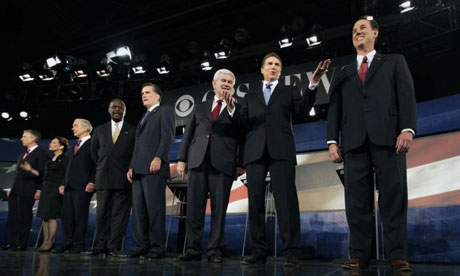
I've made it a point not to obsess over the GOP debates this year. Yeah, they've been reliable car wrecks by the side of the road, making it hard not to look to spot the injured. But if there are any injuries, it's more likely than not the truth that suffers. Though Rick Perry has sorely tested that thesis.


I'm a partisan. I want more Democrats than Republicans to get elected, and I try to be explicit when discussing why. I'm reasonably good at avoiding name-calling. And yet I can't help but be shocked by the vapidity of many of the answers when I view the tape. It's shocking, is all.

I should like the messes the candidates get into, such as when Michele Backmann, Herman Cain, and Rick Perry explain that in spite of U.S. and international law -- which the U.S. is a signatory to -- they continue to promulgate waterboarding as a viable tool in our interrogation arsenal, in spite of, well, everything. If they were credible candidates I'd be worried. And as a partisan, I should be happy that they continue to muck up the GOP brand.

A reminder issued by Scott Pelley last night: even John McCain condemned waterboarding in his election try in 2008.

I remember when Dick Cheney warned in 2004 that if John Kerry were elected president, we were likely to get attacked again. It made no sense. Still, John Kerry didn't get elected.

Channeling Cheney, there was Mitt Romney in SC declaring that if Obama is reelected Iran will surely have the Bomb. If Mitt is elected, he'll magically make it not so. Right.

Of course, that doesn't make sense. It's just, well, truthiness, as Stephen Colbert has instructed us. Here's how you do it: sound plausible and utter it with conviction.

If I'm elected, men will wear white boxers. If Mitt Romney is elected, they'll all turn pink. And I know what I'm talking about.

See how easy truthiness is?

“We have a president right now who thinks America is just another nation,” said former Massachusetts Gov. Mitt Romney. “America is an exceptional nation.”

Pink boxers, Mitt.

The candidates also attacked Obama for pulling the troops out of Iraq, which he's doing while following a status-of-forces agreement forged in the Bush administration. Of course, any of the GOP candidates could have strong-armed the Iraqis into letting the troops stay.

Yep, pink boxers.

There is not much else that was memorable at the Republican debate in SC. Seriously. With one exception: the audience applauded when Cain, Bachmann, and Perry went all waterboarding on us. That might set a record for the greatest number of weird stuff happening at debates. First, it was cheering when Rick Perry was asked about his highest-in-the-nation execution rate in Texas. Then it was shouting "Yeah!" when it was suggested that people who died because they didn't have health insurance deserved it. Finally, there was the booing of the gay soldier. Real classy.

Let's review: the GOP debate audiences have, variously, cheered executions, support the deaths of the uninsured, booed gay soldiers, and endorsed torture. I hope their moms weren't watching -- and that the voters were.

There is one conclusion I have yet to consider. Is what's on display on the stage of these debates -- and in the audiences -- emblematic of the true feelings of today's GOP? If it is, they, or we, are in trouble.

You know, like Mitt Romney's foreign policy

 Update: Today, Senator John McCain announced that he was "very disappointed" with the endorsement of waterboarding as an "enhanced interrogation technique."

"It's contrary to America's traditions," he said. "It's contrary to our ideals. That's not who we are. That's not how we operate. We don't need it in order to prosecute the war on terrorism. And we did the right thing by ending that practice."

Also, since Mitt Romney didn't weigh in on the subject during the debate, I kept him out of the controversy. However, The Washington Post reported today that:
Mitt Romney did not weigh in during the debate, but aides later told reporters that the former Massachusetts governor does not believe waterboarding is torture and did not rule out its use in a Romney administration.
So, there you have it. Gingrich, by the way, seems to have fallen through the cracks, on torture anyway. But according to a PPP poll out today, he's the frontrunner, with 28% to Cain's 25%. Romney slips to 3rd with 18%. Remember, Gingrich was all but written off months ago, by Republicans! Yowzah.

My lead's gonna be thi-i-s-s big!

Thursday, November 10, 2011

Castles Made of Sand, Castles Made of Hot Air

This morning I was struck by a comment left on the The Week magazine site pertaining to an article about whether Mitt Romney's near-cloning of Paul Ryan's poleaxing of Medicare amounted to the resurrection of the Democrats' plan for a public option for healthcare. In addition to privatizing Medicare while handing seniors vouchers, which won't cover the cost of private insurance, Romney adds a public option to the mix, allowing seniors to retain the old Medicare as an option, but only to the extent that the cash voucher would allow. In other words, it's virtually certain that the voucher amount won't be able to pay for what Medicare provides today. The comment by nem0.n00ne on The Week read:
Yea Rick [another commenter], the secret of a successful business is to have your customer base die. That's a really brilliant business plan....... If you really believe that government civil service drones will take better care of you than the market, I suggest that you move to the reservation of any American Indian tribe without a casino and see what that does for your life expectancy.
Rick had said:
Uggh. The power of the market? Puh-leaze. It's in your insurers [sic] best interest that, if you get really sick, you die quickly. I don't want the "market" looking out for my health.
Okay, let's take a look at that. Our market-based solution versus a mix of market-based, single-payer, and government healthcare systems (click for larger version):


And to remind us of the outcomes (click for larger version):


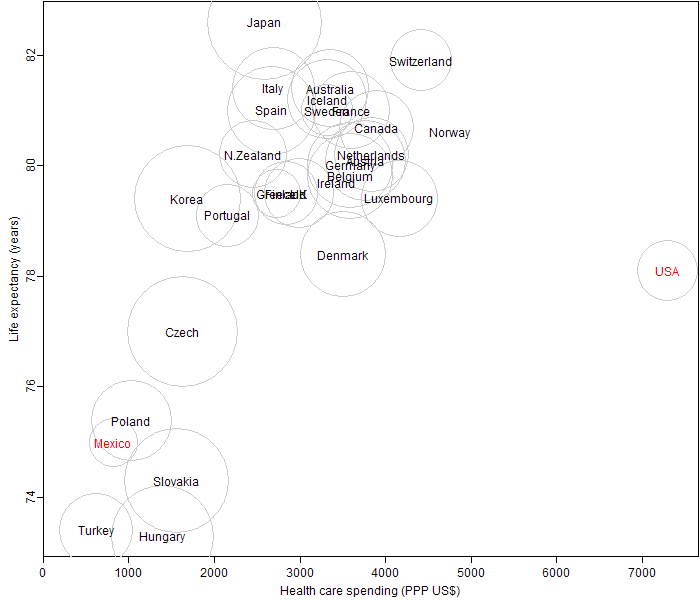
And our life expectancy relative to our expenditures compared to other countries (click for larger version):


So, what I want to know is whether our friendly commenter at The Week would stand by his comment. The facts have been available for all to see that we shouldn't be comparing our healthcare results to Indian reservations. We should be comparing them to the rest of the world.

It's clear our system sucks. What's not clear is how we get the truth out.

Speaking of the truth, is there any in this new ad (supported by an ad by of $600,000) by Karl Rove's Crossroads GPS? See for yourself:


Here's the actual video stolen and misrepresented by Rove:


As Digby said in her reaction to the ad:
This isn't ideological. It's sheer lizard brain tribalism. I don't know if Rove has found the right buttons to push, but considering what we're seeing and reading from Fox and the Murdoch papers (not to mention the blogospheric fever swamps like Powerline) I'd have to guess they know their audience. The questions is whether there are enough of them to make a difference. Massachusetts is obviously going to be one of the battlegrounds.
 With Rove and unlimited corporate expenditures, it's looks like we've got to get ready for some real trench warfare. It used to be called politics. I'm not sure what we should call it now.